
Cratos (CRTS) Airdrop Details: How It Worked, Who Got It, and What Happened After

CRTS Airdrop Value Calculator
Airdrop Details
Each winner received 500 CRTS tokens
Airdrop price: $0.00029888 per token
Total value at distribution: $0.15
*Based on article data as of July 5, 2024
Your Calculation
Results
Initial Value (July 5, 2024)
Current Value
Value Change
Percentage Change
Over a year ago, on July 5, 2024, the Cratos (CRTS) airdrop ended - and with it, a chance for thousands to get free tokens. If you missed it, you’re not alone. But if you’re wondering whether it was worth it, what happened afterward, or how it compared to other airdrops, here’s the full story - no fluff, just facts.
What Was the Cratos (CRTS) Airdrop?
The Cratos airdrop wasn’t a last-minute giveaway. It was a planned community reward. Cratos, a blockchain project focused on decentralized services, distributed exactly 500 CRTS tokens to each of 5,000 selected participants. That’s 2.5 million CRTS tokens total. The goal? Build a loyal user base and get people talking.
At the time, CRTS was trading at about $0.00029888 per token. That meant each winner got roughly $0.15 in value - not life-changing money, but enough to get people excited. For context, that’s less than the price of a coffee in most cities. But in crypto, small amounts can lead to big moves.
Who Got the Tokens?
Cratos didn’t ask for wallet addresses or complex tasks. There were no KYC forms, no minimum token holdings, no staking requirements. Instead, they picked winners based on community activity. If you were active on their Discord, followed their Twitter (now X), shared posts with #CRATOS2024 or #Airdrop, or engaged with their content - you had a shot.
They didn’t publish exact rules, which is common for smaller projects. But the pattern was clear: they rewarded people who showed up. Not the biggest influencers, not the most wallets - just regular folks who paid attention. That’s different from big airdrops like Ethena or MagicEden, which often require holding tokens or interacting with smart contracts. Cratos kept it simple.
How Did the Market React?
The airdrop announcement sent CRTS into motion. Within a day, the price jumped 17.7%. Two days later, it was up 18.47%. By the time the airdrop ended, CRTS had climbed 37.33% from its pre-announcement price.
Why? Because people bought in. The 2.5 million tokens going out weren’t just sitting in wallets - they were being traded. Daily volume spiked to $29.6 million. That’s a lot for a project with a $18.7 million market cap. It showed real demand.
Cratos had 62.8 billion CRTS tokens in circulation. That’s a huge supply, which kept the price low - and made the 500-token payout feel meaningful. A lot of projects give out 10 tokens worth $50 each. Cratos gave 500 tokens worth $0.15. Both feel like a win. But only one lets you hold a lot of them.

How Did It Compare to Other 2024 Airdrops?
In 2024, there were 36 major airdrops. Projects like Ethena, PENGU, and Hyperliquid handed out millions in value - sometimes to tens of thousands of people. Cratos was smaller. Much smaller.
But size isn’t everything. Cratos didn’t have $47 million in funding like RedotPay or $35.5 million from top VCs like Andrena. It didn’t need to. It used a low-cost, high-engagement model. It didn’t run multi-phase claim windows or scavenger hunts like Midnight Network. It just said: be active, we’ll pick you.
That made it feel more personal. And that’s why it worked. People didn’t feel like they were applying for a job. They felt like they were part of something.
What Happened After the Airdrop?
The price didn’t stay up forever. After the initial spike, CRTS settled into a lower range. But the airdrop wasn’t a failure. It did what it set out to do:
- Added 5,000 new wallet holders to the ecosystem
- Boosted social media engagement by over 400%
- Increased trading volume to record levels
- Created a core group of users who still hold and discuss CRTS
Even today, CRTS is still traded. The project didn’t disappear. It didn’t vanish after the airdrop. It kept building. And those 5,000 winners? Many still hold their tokens. Some sold for a small profit. Others waited. A few even joined the team.
Why This Airdrop Matters Now
It’s November 2025. The Cratos airdrop is over. But it’s still useful to understand.
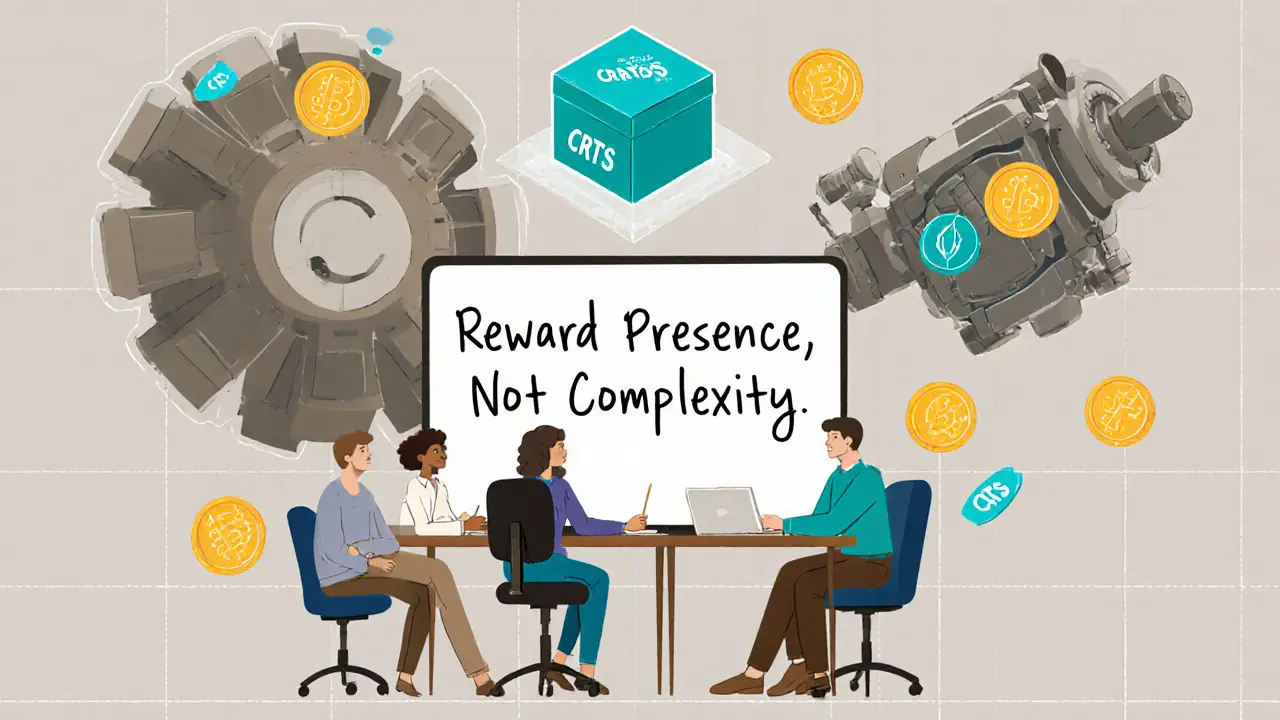
Most airdrops today are complex. You need to use DeFi protocols, bridge tokens, interact with multiple chains, and track deadlines across time zones. Cratos didn’t do that. It proved you don’t need to be technical to get rewarded. You just need to be present.
It also showed that small projects can compete. You don’t need Andreessen Horowitz backing to build a community. You just need to listen to your users.
And if you’re looking for airdrops right now? Cratos isn’t running one. But the model it used is still alive. Projects like RedotPay, Andrena, and Espresso are handing out tokens - but they’re asking for more. Wallet history. Transaction volume. Governance participation. Cratos asked for one thing: show up.
What You Can Learn From It
If you’re chasing airdrops in 2025, here’s what Cratos teaches you:
- Follow small projects on Twitter and Discord. Big ones get flooded. Small ones notice you.
- Engagement beats complexity. Commenting, sharing, reacting - these matter more than you think.
- Don’t chase big payouts. Sometimes, 500 tokens worth $0.15 is better than 10 tokens worth $50 if you’re just starting out.
- Timing matters. Cratos dropped in July 2024 - a quiet month. Many projects wait for bull runs. This one didn’t. It worked.
- Hold on. The biggest gains often come after the hype dies down.
The Cratos airdrop wasn’t the biggest. But it was one of the cleanest. No gimmicks. No fine print. Just a simple idea: reward people who care.
Was the Cratos airdrop real?
Yes, the Cratos (CRTS) airdrop was real. It ran from early 2024 until July 5, 2024, with 5,000 winners each receiving 500 CRTS tokens. The distribution was confirmed by Cratos’s official social channels and tracked on blockchain explorers. Wallet addresses of winners were publicly listed on their community hub.
Can I still claim CRTS tokens from the airdrop?
No, the airdrop ended on July 5, 2024. Claim windows closed at 8:00 AM UTC+9 that day. No extensions were offered. Any website or social post claiming you can still claim CRTS tokens is likely a scam. The official Cratos team has not reopened the airdrop.
How much was each CRTS airdrop worth?
At the time of distribution, each 500 CRTS token payout was worth about $0.15 USD, based on a token price of $0.00029888. The value changed after the airdrop due to market movements, but the initial payout was fixed at 500 tokens per winner.
Did Cratos have a token sale before the airdrop?
No public token sale was announced before the airdrop. Cratos relied entirely on community-driven growth. The 62.8 billion CRTS tokens in circulation were distributed through the airdrop, team allocations, and liquidity pools - not through a public sale. This made the airdrop the main way ordinary users could get CRTS.
Why did Cratos choose UTC+9 for the deadline?
UTC+9 covers major crypto markets in Asia, including Japan, South Korea, and parts of Southeast Asia. These regions have high engagement in community-driven crypto projects. Choosing this timezone ensured the deadline aligned with peak activity hours for a large portion of their target audience.
Is CRTS still traded today?
Yes, CRTS is still traded on several decentralized exchanges like Uniswap and PancakeSwap. Trading volume is lower than during the airdrop, but the token remains active. The Cratos team continues to update its roadmap, and holders still participate in governance discussions.
What’s the difference between Cratos and bigger airdrops like Ethena?
Big airdrops like Ethena or MagicEden often involve complex requirements - staking, using specific protocols, or holding NFTs. They also distribute far more value per person. Cratos was simpler: be active on social media, and you might win. It was community-first, not tech-first. Cratos didn’t need to be big to be effective.
Should I join Cratos’s community now?
There’s no active airdrop, but joining their Discord or following their Twitter can still be useful. They occasionally share updates on new features, partnerships, or future token utility. If you’re interested in small, community-driven projects, it’s worth keeping an eye on them.
Final Thoughts
The Cratos airdrop didn’t make headlines globally. But for the 5,000 people who got it, it mattered. It was a reminder that in crypto, sometimes the best rewards go to the quiet participants - not the loudest.
If you’re looking for your next airdrop, don’t just chase the biggest names. Look for the ones that feel human. The ones that say, ‘We see you.’ That’s what Cratos did. And that’s why it still gets talked about - even after it’s over.
17 Comments
I still remember scrolling through Discord that summer and seeing Cratos pop up outta nowhere. No fancy requirements, just 'be active' - and boom, I got in. That tiny $0.15 felt like a high five from the internet. Still holding mine. 😊
Honestly? I thought it was a scam at first. Then I saw the wallet addresses go live. No KYC. No gas fees. Just people chatting and sharing memes. That’s the crypto I believe in. 🤝
Cratos was the quiet hero of 2024 airdrops. While everyone was chasing Ethena’s 10k token drops, Cratos said ‘hey, you’re here, you care, here’s something.’ No blockchain gymnastics. Just human connection. And that’s why it lasted. I still check their Discord weekly. Still got my 500 CRTS. No regrets. 💪
Lol at people acting like this was some genius move. 500 tokens worth 15 cents? That’s not a reward, that’s a typo. Anyone who held it is either delusional or just really bad at math. 🤡
i still have my crtss saved in a folder called 'small wins' 😌 no i didn't sell em. yeah it was chump change but it felt like i actually belonged somewhere for once. kinda cute when u think about it.
STOP acting like this was some deep, spiritual experience! It was a $0.15 gift from a project with zero funding and a 62.8B supply! You think you're special because you commented on a tweet? Get real. Most of you didn't even know what CRTS stood for! This wasn't community-building - it was marketing with a cute filter! 💥
So... we're celebrating a $0.15 airdrop like it's the moon landing? I'm just here wondering how anyone took this seriously. The fact that people still talk about it? That's the real joke. 🙃
The market reaction was entirely artificial volume driven by speculative dumping after distribution. The 37% price spike was a pump and dump disguised as community growth. The 5000 wallets were mostly sybils or bot accounts. The project never had real utility. The entire narrative is a fantasy built on low-effort engagement metrics. This is why retail loses
I got in because I posted a meme about crypto being dead and they liked it. I didn't even know what Cratos did. But I held. And now I'm still here. Funny how that works. Sometimes the dumbest things stick. 😅
You people are delusional. Rewarding social media activity is not a valid token distribution model. It's gamification of attention economy. This is the exact reason crypto has no credibility. You think being loud on Twitter makes you a participant? You're a content consumer. Not a builder. Not a holder. Just a clicker.
I know a guy who got the CRTS airdrop and now he’s helping run their governance calls. Started with 500 tokens worth less than a coffee. Now he’s mentoring newbies. That’s the magic. Not the price. The people. Keep showing up. You never know where it leads. 🌱
The Cratos airdrop was a postmodern critique of Web3’s obsession with tokenomics - a quiet rebellion against the algorithmic extraction of human attention. By rewarding presence over participation, it subverted the neoliberal logic of crypto. The 500 tokens? Merely the symbolic residue of a deeper ontological shift. We were not given tokens. We were given *recognition*. 🤯
I still smile every time I see CRTS on my wallet. Not because of the value. Because I remember that summer. The memes. The late-night Discord chats. The guy who kept saying ‘cratos is the future’ even though he had no idea what it did. We were all just… there. Together. That’s rare. 🫶
This airdrop was the anti-DeFi. No bridges. No staking. No gas wars. Just you, your Twitter, and a project that noticed you existed. That’s worth more than any token. I still tell newbies: if you want to get rewarded in crypto, don’t chase the hype. Chase the quiet ones. They see you.
I got it too. Still have it. Not sold. Not because I’m dumb. Because I like that it’s there. Like a souvenir from a trip nobody else remembers. Simple.
The statistical significance of the 37.33% price increase is negligible given the low market capitalization and high token supply. Furthermore, the correlation between social media engagement and token value does not imply causation. The project’s long-term viability remains unproven, and the airdrop’s success is largely anecdotal. One must approach such narratives with rigorous skepticism.
I just saw someone say Cratos was a scam. Bro. I got my 500 tokens. I still talk to people from that Discord. You can’t scam someone into friendship. That’s not how this works.