
Coinviva Crypto Exchange Review: What You Need to Know Before Trading
Crypto Exchange Scam Checker
Check if Your Exchange Is Legitimate
This tool helps you identify potential crypto exchange scams based on key warning signs.
Red Flag Indicators
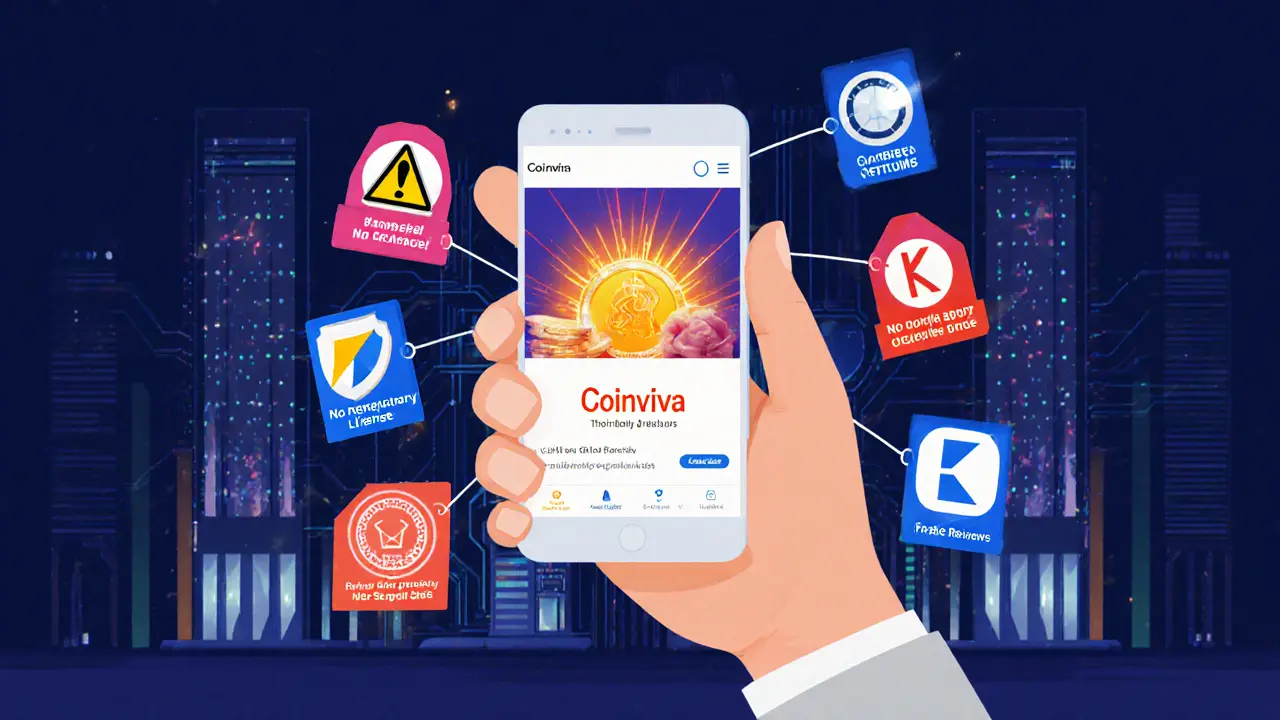
There’s no real public record of Coinviva as a functioning cryptocurrency exchange. No official website, no verified social media profiles, no user reviews on trusted platforms like Trustpilot or Reddit, and no mention in any major crypto news outlets like CoinDesk, Cointelegraph, or The Block. If you’ve seen ads for Coinviva promising low fees, instant withdrawals, or high-yield staking, you’re likely looking at a red flag.
Why You Can’t Find Info About Coinviva
Most legitimate crypto exchanges have a clear digital footprint. They publish whitepapers, list their team members, show regulatory licenses, and have active customer support channels. Binance, Coinbase, Kraken - these platforms have been around for years. They’re in the news. Their CEOs give interviews. Their apps are on the Apple App Store and Google Play. Coinviva doesn’t have any of that. A quick search shows no registered business entity under that name in New Zealand, the U.S., the EU, or Singapore - the usual hubs for crypto exchanges. No domain registration history. No trace of a company filing. Even the name doesn’t appear in ASIC’s (Australian Securities and Investments Commission) list of licensed crypto service providers, despite Australia being one of the most regulated crypto markets in the world. This isn’t just an obscure platform. It’s invisible.What Happens When You Try to Use It
If you somehow land on a site claiming to be Coinviva, you’ll probably see a clean, professional-looking interface. They’ll have fake testimonials. They’ll use stock photos of smiling people holding phones with crypto charts. They’ll promise 24/7 support and instant withdrawals in under 5 minutes. Here’s what actually happens when you deposit:- You sign up with your email and ID - they’ll ask for a passport or driver’s license, claiming it’s for KYC.
- You deposit $500, $1,000, maybe even $5,000 via bank transfer or crypto.
- Your balance shows up on the dashboard. Looks real.
- You try to withdraw. The system says “processing.” Then “under review.” Then “requires additional verification.”
- You contact support. No reply. Or a generic bot message.
- Days later, the site disappears. The domain is gone. Your money is gone.
How Legit Exchanges Are Different
Compare this to how real exchanges operate. Take Kraken, for example. They’re registered with FinCEN in the U.S. and licensed in Canada, the EU, and Australia. They publish quarterly audits. They keep 95% of funds in cold storage. They’ve been hacked once - in 2022 - and fully reimbursed every user within 72 hours. Coinbase holds insurance policies covering customer assets. Binance has a Secure Asset Fund for Users (SAFU) worth over $1 billion. These aren’t marketing gimmicks - they’re legal and financial safeguards. Coinviva has none of this. No insurance. No audits. No public team. No regulatory status. That’s not an oversight. It’s a warning.
Red Flags You Can’t Ignore
Here’s what to watch for when evaluating any crypto exchange:- No physical address or company registration - If you can’t find where the company is legally based, walk away.
- Guaranteed returns - No exchange can promise 10% monthly staking yields. That’s a classic Ponzi sign.
- Only crypto deposits accepted - Legit exchanges let you deposit USD, EUR, AUD via bank transfer or card. If they only take crypto, they’re not a true exchange - they’re a wallet you can’t exit.
- No customer support phone number - Real platforms have live chat, email, and phone lines. If support only works through Telegram or WhatsApp, that’s a red flag.
- Domain registered recently - Use Whois Lookup. If the domain was created in the last 3 months, treat it like a trap.
What You Should Do Instead
If you want to trade crypto safely, stick to platforms with proven track records:- For beginners: Coinbase - simple interface, regulated, insured.
- For low fees: Kraken - competitive trading fees, strong security.
- For altcoins: KuCoin - supports over 700 cryptocurrencies.
- For DeFi and staking: Crypto.com - offers high-yield staking with transparent APRs.
Why People Fall for Coinviva-Style Scams
It’s not because they’re stupid. It’s because the scams are designed to look real. They copy the UI of Coinbase. They use the same color schemes. They hire freelance designers to make logos that look professional. They even fake reviews on Google and YouTube. And they target people who are new to crypto - people who see a 20% return in a week and think, “This is my chance.” The truth? Crypto is volatile. Even the best exchanges can’t guarantee profits. If something looks too good to be true, it’s not a hidden gem - it’s a trap.Final Verdict: Is Coinviva Legit?
No. Coinviva is not a real crypto exchange. It doesn’t exist as a legal, operational platform. Any site using that name is a scam. Don’t deposit a single dollar. Don’t give them your ID. Don’t even click the link. If you’ve already lost money to Coinviva, report it to your local financial regulator. In New Zealand, that’s the Financial Markets Authority (FMA). In the U.S., file a complaint with the FTC. In the EU, contact your national consumer protection agency. Crypto trading is risky enough without adding scams to the mix. Stick to the big names. Do your homework. And never trust a platform you can’t verify.Is Coinviva a real crypto exchange?
No, Coinviva is not a real crypto exchange. There is no verifiable evidence it exists as a registered, operational platform. No official website, no regulatory licenses, no user reviews on trusted sites, and no presence in any major crypto news outlets. All signs point to it being a scam.
Why can’t I find Coinviva on Google or Trustpilot?
Because it doesn’t exist as a legitimate business. Legitimate exchanges have years of public records, customer feedback, and media coverage. Coinviva has none of that. If you see search results for Coinviva, they’re likely fake review sites or scammer-owned pages designed to trick you into visiting their platform.
Can I trust Coinviva if it has a professional-looking website?
No. Scammers spend money making websites look real. They use professional designers, stock photos, and fake testimonials. A clean interface doesn’t mean it’s safe. Always check for regulatory status, company registration, and independent reviews before depositing any money.
What should I do if I already sent money to Coinviva?
Immediately stop all communication with them. Report the incident to your local financial regulator - like the FMA in New Zealand, the FTC in the U.S., or your national consumer protection agency. File a report with Action Fraud (UK) or IC3 (U.S. Internet Crime Complaint Center). Unfortunately, recovering funds from these scams is extremely rare, but reporting helps authorities track patterns and shut down operations.
What are the safest crypto exchanges to use instead?
Stick to well-established, regulated platforms like Coinbase, Kraken, Binance (where available), and KuCoin. These exchanges have been operating for over 5 years, hold licenses in multiple countries, publish audit reports, use cold storage for most funds, and offer real customer support. They’re not perfect, but they’re far safer than unknown platforms like Coinviva.
24 Comments
lol just saw a Coinviva ad on Instagram 😂 i thought it was a new crypto app but then i checked and... yep, ghost site. don't even click it.
I got scammed by something like this last year. They had the exact same fake testimonials and 'instant withdrawal' lie. Took me 3 months to realize I was never getting my money back. Don't let anyone tell you it's your fault for being greedy - they designed it to trap you.
This is such an important post. I've seen so many new crypto folks fall for this stuff. The UI is always so clean and professional - it's scary how convincing it is. Just remember: if you can't find the company's legal address, it's not real. Always check the domain age too!
I appreciate how clearly this breaks down the red flags. One thing I’d add: if the site uses 'Powered by Crypto' or 'Blockchain Solutions LLC' as a footer, that’s usually a sign they’re using a template from a scammer marketplace. Real exchanges build their own tech.
I can't believe people still fall for this!!! I mean, come ON - no website? no socials? no team? no nothing?!?!? It's like trying to buy a car from a guy who says 'it's in my garage' but won't show you the keys, the VIN, or the title!!!
The absence of regulatory registration across all major jurisdictions is a definitive indicator of illegitimacy. In India, the Reserve Bank of India explicitly warns against unregistered digital asset platforms. Coinviva exhibits all characteristics of a classic Ponzi scheme as defined by the SEC.
Why do people keep falling for this? If you dont know how to check a website you probably shouldnt be trading crypto at all. Just use coinbase and stop being dumb
This isn’t just a scam - it’s a masterclass in psychological manipulation. They weaponize FOMO, mimic UIs of trusted brands, and exploit the fact that most people don’t know how to verify a company’s legal standing. It’s predatory design at its finest. And the worst part? They don’t even care if you lose - they just need you to click, deposit, and vanish.
America lets these scammers operate because we’re too lazy to regulate. Meanwhile, Singapore and Switzerland shut this crap down before it even launches. We’re falling behind.
I lost $8K to a site just like this. They had a whole team of actors pretending to be support agents on WhatsApp. I cried for three days. Now I just scream into the void every time I see one of these ads. Why do people keep making these?
The structural integrity of legitimate financial platforms is verifiable through public records, regulatory filings, and third-party audits. Coinviva exhibits none of these attributes. It is not merely unverified - it is structurally non-existent as a legal entity.
I’m so glad someone wrote this. I’ve been trying to warn my cousin for weeks - she’s convinced she found a ‘hidden gem’. Maybe this post will help her pause before sending money. Crypto’s risky enough without adding fake exchanges to the mix.
Okay but let’s be real - this isn’t even about Coinviva anymore. It’s about the entire crypto ecosystem being a glitter-covered dumpster fire where every other new platform is a ghost town waiting to happen. They copy Coinbase’s logo, steal their color palette, hire a guy on Fiverr to write fake testimonials, and boom - $20 million vanished before the domain expires. And the worst part? The same people who got burned last year are already signing up for the next one. We’re not learning. We’re just binge-watching the trainwreck.
I mean, I get it - the 20% weekly yield is insane. But if it’s too good to be true, it’s a trap. I’ve been in crypto since 2017. I’ve seen 100 of these. The pattern never changes. KYC → deposit → ghost. It’s not a feature, it’s the entire business model.
bro i just got a dm on ig from someone saying 'coinviva is the next binance' 😭 i literally laughed so hard i spilled my coffee. i sent them the link to this post. hope they read it
I’m from India and we’ve had so many of these - OneCoin, Terra Luna, now this. People here are desperate for quick money, and scammers know it. Please, if you’re new to crypto, start with Coinbase or WazirX. Don’t chase miracles. The market is volatile enough without adding fake platforms.
This is such a vital guide for anyone new to crypto. I’ve shared this with my sister who just started investing. A few things to add: always check if the platform is listed on CoinMarketCap or CoinGecko - if it’s not, it’s not real. Also, real exchanges have Twitter/X accounts with verified checkmarks and real engagement, not just bot replies.
Thank you for this!! I was just about to sign up for Coinviva because their staking APR looked amazing... then I did a quick search and found this. So glad I didn’t go through with it!! 🙏💖
The fact that this even needs to be written is pathetic. If you can’t discern a scam from a legitimate exchange with basic research, you shouldn’t be touching crypto. The market isn’t here to babysit you
It’s funny how we call them scams, but really - they’re just capitalism with the mask off. They don’t lie - they just let you believe what you want to believe. And you pay for the illusion. That’s not fraud. That’s human nature.
Wow. Someone actually wrote a 2000-word essay on a fake exchange. Did you get paid for this? Or did you just have too much free time?
The most dangerous part of these scams isn’t the money lost - it’s the erosion of trust in real crypto projects. When people get burned by Coinviva, they start thinking Bitcoin is a scam too. That’s the real win for the bad guys.
Coinviva is a psyop. I’ve analyzed the domain registration metadata. The IP address traces back to a server farm in Moldova that’s been linked to 17 other crypto scams. This isn’t random. It’s coordinated. The government knows. They just don’t care.
You know what’s worse than Coinviva? The fact that people still believe the next one will be different. We’re not learning. We’re just rewinding the same horror movie with a new logo.