
Celestia and Modular Blockchain Projects: The Future of Scalable Web3 Infrastructure

Why Monolithic Blockchains Hit a Wall
You might have noticed that as Ethereum or Bitcoin get more popular, they also get slower and more expensive to use. It’s not just bad luck; it’s by design. Traditional blockchains are what experts call monolithic architectures. They try to do everything at once: process transactions, reach consensus on the order of those transactions, and store all the data forever. Think of it like trying to drive a car while simultaneously fixing the engine and navigating with a paper map. It works for a small group, but when millions of people join, traffic jams happen. Gas fees spike, and confirmation times drag out.
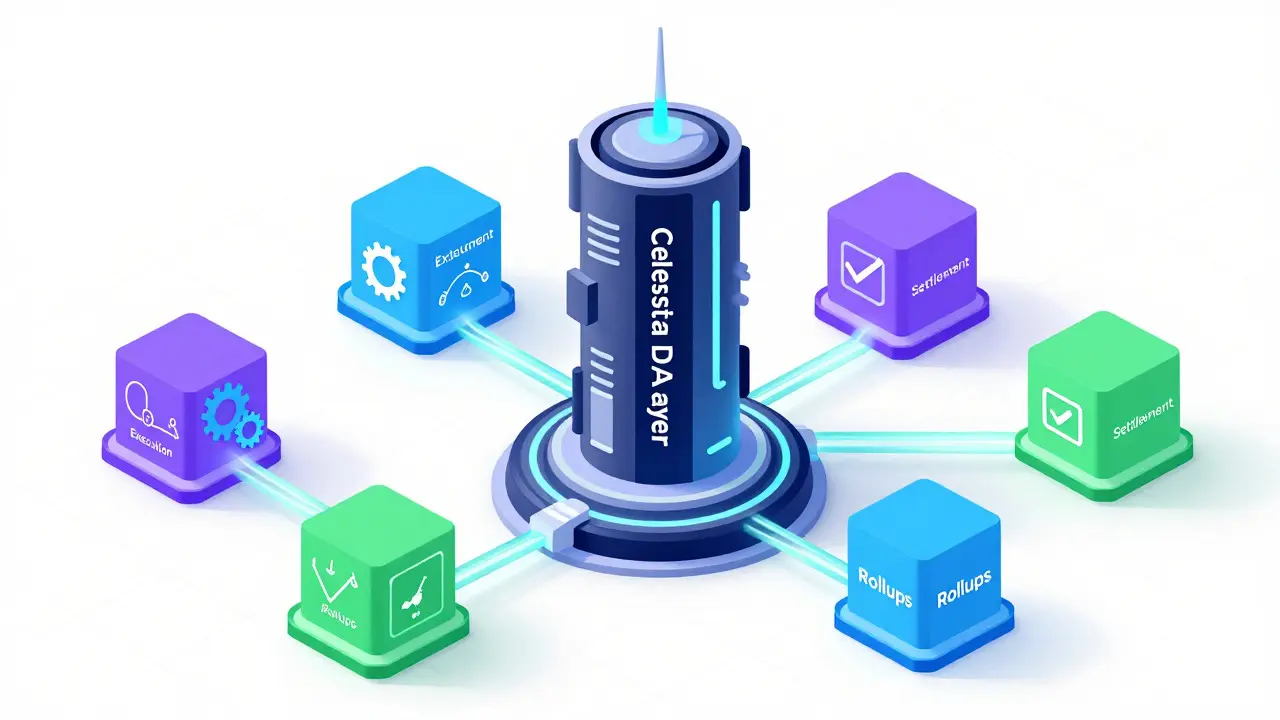
This is where the concept of modular blockchain projects comes in. Instead of one chain doing it all, why not split the work? This approach breaks the blockchain into specialized layers. One layer handles execution (processing logic), another handles settlement (finalizing results), and a third handles data availability (ensuring data isn’t lost). This separation allows each part to scale independently. If you want faster transactions, you upgrade the execution layer without breaking the security of the data layer. This shift is reshaping how developers build decentralized applications, moving away from the "one-size-fits-all" model that has dominated crypto since its inception.
Introducing Celestia: The Data Availability Pioneer
Among the new wave of modular solutions, Celestia stands out as a dedicated data availability network. Launched in October 2023, Celestia doesn’t try to be an application platform like Ethereum. Instead, it focuses on one critical job: making sure transaction data is available and verifiable. By offloading this heavy lifting from main chains, Celestia enables other blockchains-specifically rollups-to scale massively without sacrificing decentralization.
The team behind Celestia includes industry veterans like Mustafa Al-Bassam, co-founder of Chainspace, and Ismail Khoffi, a former Tendermint engineer. Their vision was clear: solve the blockchain trilemma (security, scalability, decentralization) by specializing. Celestia raised $55 million in funding, achieving unicorn status with backing from giants like Coinbase Ventures and Jump Crypto. This capital wasn’t just for marketing; it funded deep technical research into how we can verify data without downloading it all.
How Data Availability Sampling Changes the Game
To understand why Celestia is revolutionary, you need to look at its core technology: Data Availability Sampling (DAS). In traditional systems, if you want to verify that a block of data exists, you usually have to download the entire block. As blocks grow larger to accommodate more transactions, this becomes impossible for average users running nodes on laptops. Centralization creeps in because only powerful data centers can afford the storage and bandwidth.
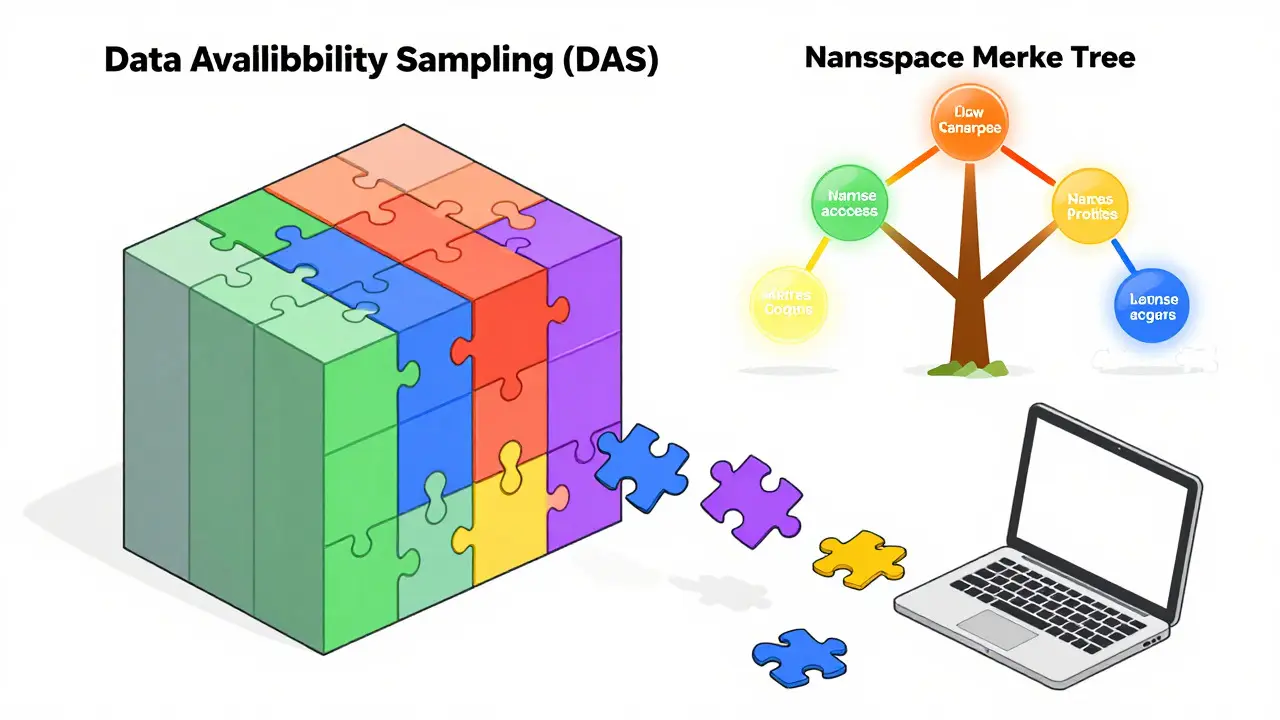
DAS flips this script. It uses a mathematical technique called erasure coding. Imagine you have a 1MB file. Erasure coding expands it to 2MB by adding redundant data. Now, even if half the data is missing, you can reconstruct the original file. On Celestia, nodes don’t need to download the whole block. They just take random samples. If the samples check out, the node can be statistically certain that the data is available. With just seven random requests, the probability of verification accuracy jumps to over 99%. This means anyone with a modest computer can run a node and help secure the network, keeping the system truly decentralized.
The Role of Namespace Merkle Trees
Another key innovation in Celestia’s architecture is the Namespace Merkle Tree (NMT). In a monolithic chain, all transactions are mixed together. But in a modular world, different apps (dApps) need their own space. NMTs organize block data into namespaces. Each decentralized application gets its own namespace ID. When a dApp wants to read data, it only needs to fetch the parts of the tree relevant to its namespace. It ignores the rest. This reduces the load on individual applications and makes it easier for them to prove that specific data exists without processing unrelated transactions. It’s like having a library where every book is tagged with a unique color code, allowing you to find exactly what you need without scanning every shelf.
Celestia vs. Monolithic Chains: A Comparison
| Feature | Monolithic (e.g., Bitcoin, Early Ethereum) | Modular (e.g., Celestia + Rollups) |
|---|---|---|
| Data Handling | All nodes store all data | Data separated into DA layer |
| Scalability | Limited by node hardware | Highly scalable via parallel rollups |
| Node Requirements | High storage/bandwidth | Low requirements due to DAS |
| Flexibility | Fixed execution environment | Customizable execution layers |
| Cost | High gas fees during congestion | Lower fees via efficient data sharing |
This table highlights why developers are flocking to modular designs. Monolithic chains are secure but rigid. Modular setups like Celestia offer flexibility. Developers can choose their preferred programming language-Solidity for EVM compatibility, Rust or Golang for Cosmos SDK integration-and build custom virtual machines on top of Celestia’s reliable data layer. This freedom accelerates innovation because teams aren’t fighting against the limitations of a single chain’s upgrade cycle.
The Rise of Rollups on Celestia
Rollups are the primary beneficiaries of Celestia’s infrastructure. There are two main types: optimistic rollups and zero-knowledge (ZK) rollups. Both process transactions off-chain to speed things up, then post proofs or data back to a base layer. Previously, Ethereum served as this base layer, but its high costs made it expensive for smaller projects. Celestia offers a cheaper, faster alternative for data posting. Because Celestia specializes in data availability, it can handle massive amounts of data at low cost. This allows new rollups to launch quickly and affordably. For example, a gaming dApp can create its own rollup on Celestia, handling thousands of transactions per second while relying on Celestia’s network to ensure no data is ever deleted or hidden.
Recent Upgrades and Performance Improvements
Celestia isn’t static. The team continues to optimize the network. A major milestone was the Ginger upgrade, announced in late 2024. This update reduced block time from 12 seconds to 6 seconds, effectively doubling the throughput of data availability services. Faster blocks mean less latency for rollups waiting to confirm their data. This kind of continuous improvement shows that Celestia is actively addressing real-world bottlenecks. As the ecosystem grows, these performance tweaks become crucial for maintaining user experience across connected applications.
Challenges and Considerations for Developers
While the modular approach is promising, it’s not without challenges. Developers must understand the separation of concerns. You’re no longer building on a single stack; you’re integrating multiple layers. This requires familiarity with concepts like fraud proofs, validity proofs, and cross-chain communication. The learning curve is steeper than deploying a simple smart contract on Ethereum. However, tools and documentation are improving rapidly. The benefit is autonomy: you control your execution environment while inheriting the security of the data availability layer. For serious projects aiming for global scale, this trade-off is worth it.
Conclusion: The Shift Toward Specialization
The blockchain industry is maturing. We’re moving past the era of general-purpose chains trying to do everything. Specialization is the next logical step. Celestia represents a foundational piece of this new puzzle. By providing a robust, decentralized data availability layer, it enables a future where thousands of specialized rollups can coexist securely. Whether you’re a developer looking to build a high-performance dApp or an investor watching the evolution of Web3 infrastructure, understanding Celestia’s role is essential. The modular revolution is here, and it’s changing how we think about scalability and decentralization.
What is the main difference between Celestia and Ethereum?
Ethereum is a monolithic blockchain that handles execution, consensus, and data availability itself. Celestia is a modular data availability network that focuses only on storing and verifying data, leaving execution to separate rollups. This allows Celestia to offer lower costs and higher scalability for data-heavy applications.
How does Data Availability Sampling (DAS) work?
DAS allows nodes to verify that data is available without downloading the entire block. It uses erasure coding to expand data and statistical sampling. Nodes request random fragments of the block. If the fragments match expected patterns, the node can be confident the full data is present, enabling lightweight participation in the network.
Can I use Solidity on Celestia?
Yes, Celestia supports multiple programming languages. While Celestia itself is the data layer, developers can build rollups on top of it using Solidity (for EVM compatibility), Rust, Golang, or other languages. This flexibility allows teams to choose the best tool for their specific application needs.
What is a Namespace Merkle Tree (NMT)?
An NMT is a data structure used by Celestia to organize block data into namespaces. Each decentralized application gets a unique namespace. This allows apps to efficiently retrieve only their relevant data from the block without processing unrelated information, improving efficiency and reducing computational load.
Is Celestia secure?
Celestia uses Proof-of-Stake consensus and relies on Data Availability Sampling to ensure security. Its design ensures that data cannot be withheld or tampered with without detection. Security is further enhanced by the fact that rollups built on Celestia can implement their own fraud or validity proofs, creating a multi-layered security model.