
Buying Used vs New Mining Hardware: What Actually Wins in 2026
When you're staring at a $17,000 new ASIC miner and a $600 used S9 on the same screen, it’s easy to think the used one is the smarter buy. But in 2026, that decision isn’t about saving money-it’s about whether you’re still mining at all by next year.
Efficiency Isn’t a Bonus-It’s the Rule
The Bitcoin network isn’t just growing. It’s crushing inefficiency. In 2025, the global hashrate hit 750 exahashes per second. That means every miner, big or small, is fighting for a shrinking slice of the $20 million daily reward. And the only thing that matters now is how much electricity you burn to earn each hash.
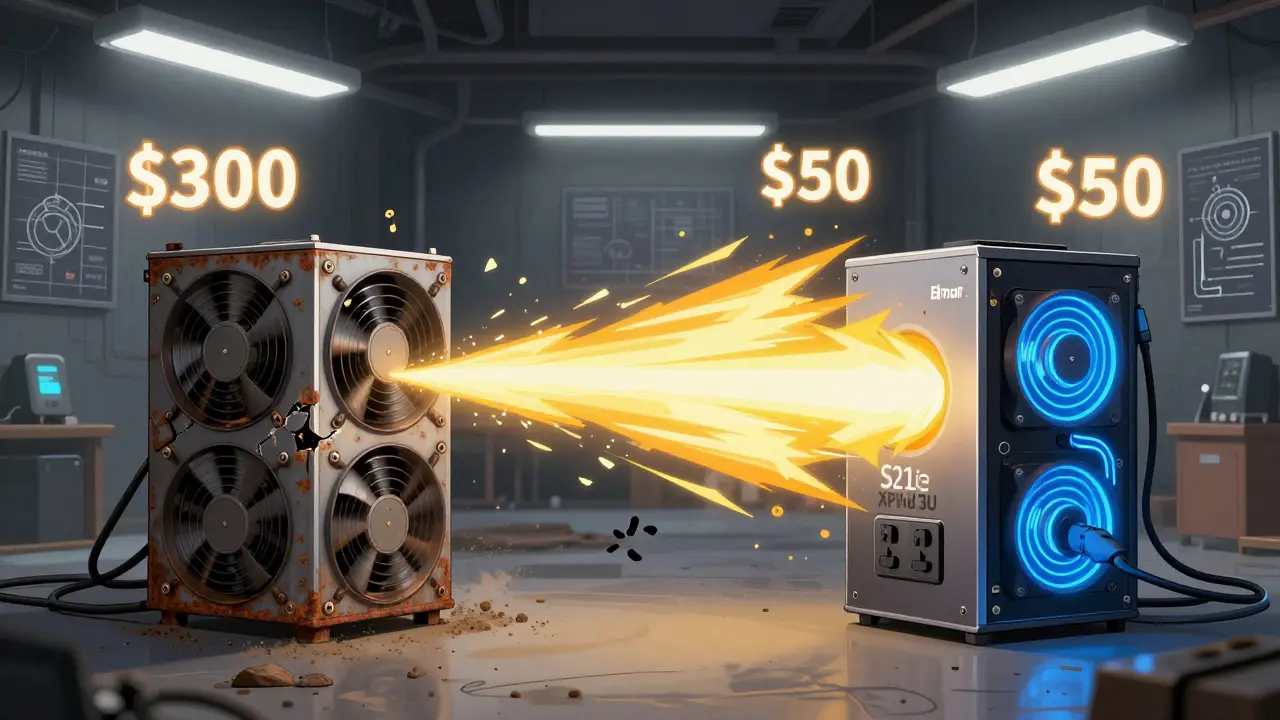
Take the Antminer S9, the old workhorse. It’s rated at 14 TH/s and uses 95 joules per terahash (J/TH). That’s like driving a 1998 pickup truck to a Formula 1 race. The new Bitmain Antminer S21e XP Hyd 3U? It does 860 TH/s at just 13 J/TH. That’s a 7x efficiency gain. At $0.10/kWh, the S9 spends over $300 a month just on power for its tiny output. The S21e? Around $50 for 20x more hash power. That’s not a difference-it’s a chasm.
And it’s getting worse. By mid-2026, experts predict any miner above 50 J/TH won’t break even. The S9 is already at 95. Even the slightly newer S19, at 30 J/TH, is on borrowed time. Efficiency isn’t a nice-to-have. It’s the only thing that keeps you alive.
Used Miners: Fast ROI, Fast Failure
Yes, a used S9 costs $600. Yes, you might see your first profit in 6 months. But here’s what no one tells you: that $600 isn’t the end of your costs.
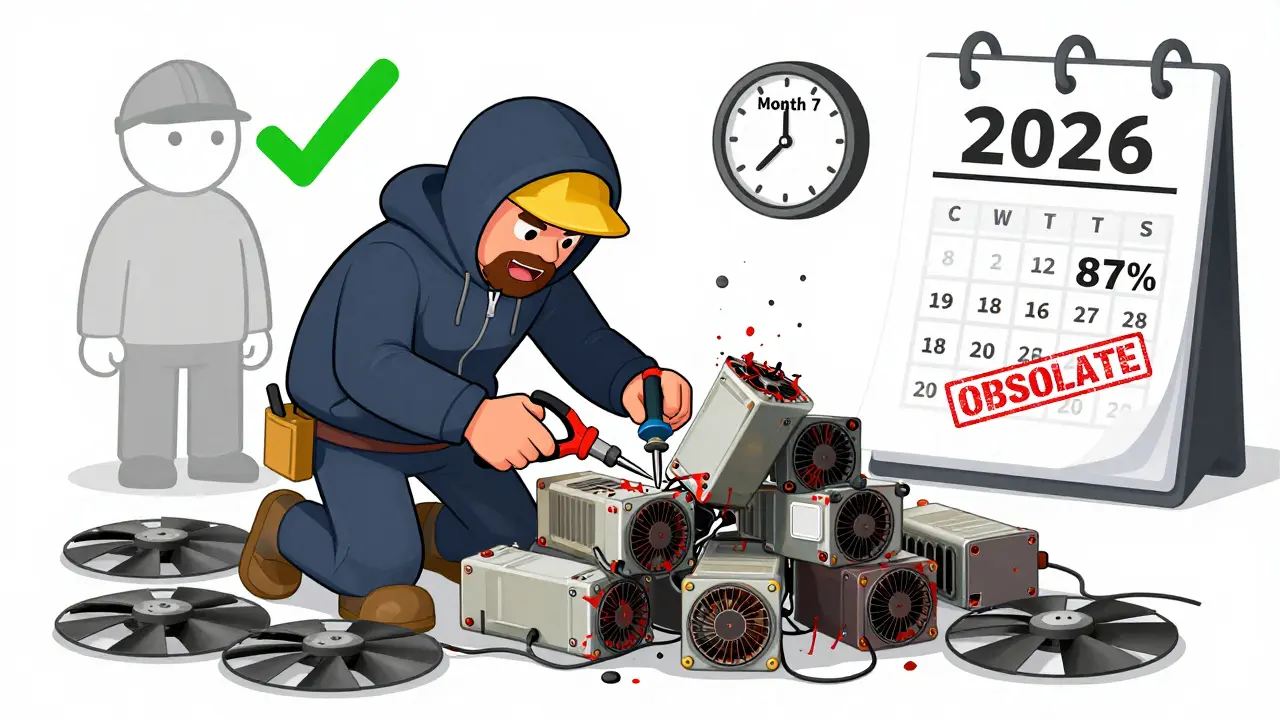
Used miners are worn out. Fans die. Power supplies fry. Cooling systems clog. On Reddit, u/MiningMaster45 said his S9 died after 11 months-and he spent $320 replacing fans and PSUs. Another user on Trustpilot admitted that by month 7, 87% of his daily earnings went straight to electricity. That’s not profit. That’s a tax.
And maintenance? It’s not optional. Users report spending 8-10 hours a week fixing, cleaning, or rebooting used units. New miners? Two to three hours. That’s not just time-it’s opportunity cost. While you’re troubleshooting a dead fan, someone else with a new miner is earning.
Even the “refurbished” units aren’t safe. A July 2025 review on ECOS’s platform praised a refurbished S19j that hit ROI in 5 months. But a June review from the same site said: “Received an S9 that failed within 3 weeks despite 'tested working' guarantee.” No warranty. No support. Just luck.
New Miners: High Upfront Cost, Lower Long-Term Risk
Yes, the S21e XP Hyd 3U costs $17,210. That’s a lot. But look at what you’re buying: a 180-day manufacturer warranty, factory firmware optimized for current difficulty, and hardware designed for modern cooling systems-including hydro-cooling, which cuts noise from 75dB down to 50dB.
And here’s the kicker: new miners hold value. After 12 months, S21 models retained 75% of their price. The S9? 25%. That’s not depreciation. That’s a liquidation risk. If you need to sell, the used market is collapsing. ASIC Marketplace reported S9 resale values dropped 40% in Q3 2025 alone.
New miners also deploy faster. You order, they arrive, you plug in. Used units? They sit in refurbishment queues for 4-6 weeks. Meanwhile, Bitcoin’s difficulty adjusts every 14 days. Every day you wait, the bar gets higher.
Who Still Buys Used?
Not you-if you’re serious about mining beyond 12 months.
Used miners only make sense for one scenario: short-term speculation. Maybe you’re betting on a Bitcoin price surge in the next 6 months and want to ride it. Or you’re testing a mining setup on a budget before committing to real capital. Even then, you need to accept you’re gambling. You’re buying a time bomb with a price tag.
Some miners use old units to mine alternative SHA-256 coins like Bitcoin Cash or Bitcoin SV. But those networks have 1/10th the value of Bitcoin. You’re not mining profitably-you’re just keeping your hardware warm.
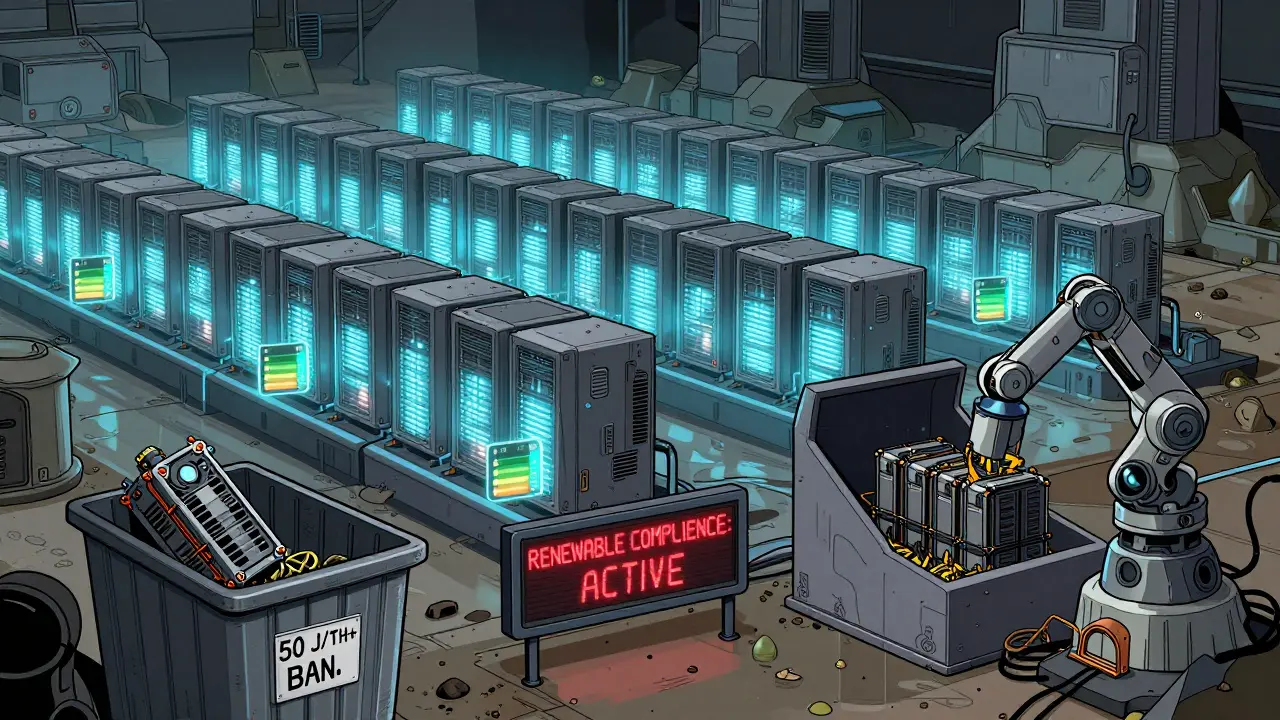
And if you’re in California, Nevada, or any region with renewable energy mandates, used miners are practically illegal. New ASICs are the only ones that meet the 30%+ renewable energy thresholds. The law isn’t coming for you-it’s already here.
The Hidden Costs Nobody Talks About
Let’s break down the real math:
- Used S9: $600 upfront. $300/month electricity. $150/year in parts. 10 hours/week maintenance. ROI in 6-8 months. Value after 12 months: $150.
- New S21e XP Hyd 3U: $17,210 upfront. $50/month electricity. $50/year maintenance. 3 hours/week maintenance. ROI in 16-18 months. Value after 12 months: $12,900.
At first glance, the S9 wins. But after 18 months? The S9 is dead. You’ve spent $600 + $5,400 electricity + $270 parts = $6,270 for maybe $150 resale. You’re out $6,120.
The S21e? You’ve spent $17,210 + $900 electricity + $75 maintenance = $18,185. But you’ve earned 1.8 BTC (at $70k/BTC, that’s $126,000). And you still own a machine worth $12,900. You’re up $107,815.
That’s not a choice. That’s a math problem with one answer.
What About Cheaper New Miners?
You don’t need the top-tier S21e. The Bitdeer SealMiner A2 Pro Hyd does 500 TH/s at 7,450W for $3,958. That’s 14.9 J/TH. Still 6x more efficient than an S9. ROI in 10-12 months. Value retention over 70% after a year.
Or the Canon Avalon Q: 18.5 J/TH, $2,000. Quiet. Reliable. Made for home miners. It’s not a flagship, but it’s not a relic either.
Even the cheapest new miner today beats the best used one. That’s the new reality.
What’s the Future Look Like?
By Q2 2026, ASICs below 50 J/TH will be obsolete. That’s not a prediction-it’s a mathematical certainty. The network difficulty keeps rising. Block rewards halve in 2028. Energy prices won’t drop. Cooling tech is moving to immersion. Old miners can’t be retrofitted. They’re dead weight.
Enterprise miners now control 82% of the hashrate. They’re buying new units. They’re using hydro-cooling. They’re tracking every joule. You can’t compete with a 1998 pickup truck in a race against Teslas.
The only reason used miners still exist is because people are clinging to the idea that mining is easy. It’s not. It’s a high-stakes, high-efficiency game. And in 2026, the only winners are the ones who bought new.