
Blockchain vs Traditional Databases: Which One Do You Actually Need?
You’ve probably heard the hype. For years, tech pundits screamed that Blockchain Technology is a decentralized, immutable digital ledger system designed to record transactions securely without a central authority. It was going to replace everything. Your bank’s server? Gone. Your company’s customer database? Obsolete. But it’s 2026, and if you look around, those traditional servers are still humming along.
So, what happened? The reality is less dramatic than the headlines suggested. Blockchain didn’t kill the database; they just started living in different neighborhoods. One handles high-speed, complex queries with ease, while the other provides unshakeable trust for strangers doing business together. Choosing between them isn’t about picking the "newer" tech. It’s about understanding exactly what problem you’re trying to solve.
The Core Difference: Trust vs. Speed
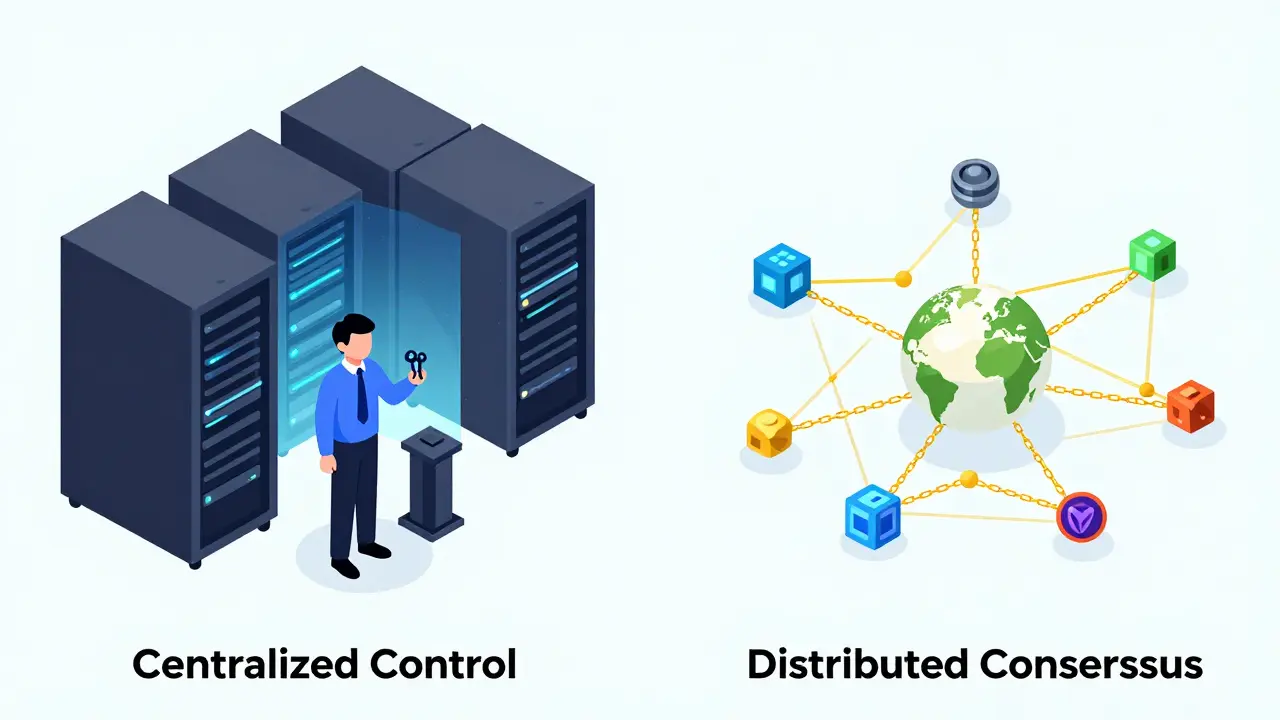
To understand why these two technologies behave so differently, you have to look at who holds the keys. In a Traditional Database is a centralized software system that organizes, stores, and retrieves data under the control of a single administrator or organization, there is a boss. That boss is usually a Database Administrator (DBA) or an IT department. They decide who can read the data, who can write to it, and when things get deleted. This centralization is actually a feature, not a bug, for most businesses. It allows for lightning-fast updates and complex management.
Now flip that model on its head. A blockchain removes the boss entirely. Instead of one server holding the truth, thousands of computers (nodes) across the globe hold identical copies of the ledger. No single entity controls the data. To change something, you don’t ask permission from an admin; you have to convince the entire network that your change is valid. This is called consensus. It creates a "trustless" environment where parties who don’t know or like each other can still agree on the state of the data. But this security comes at a steep price: speed.
How Data Is Structured: Tables vs. Chains
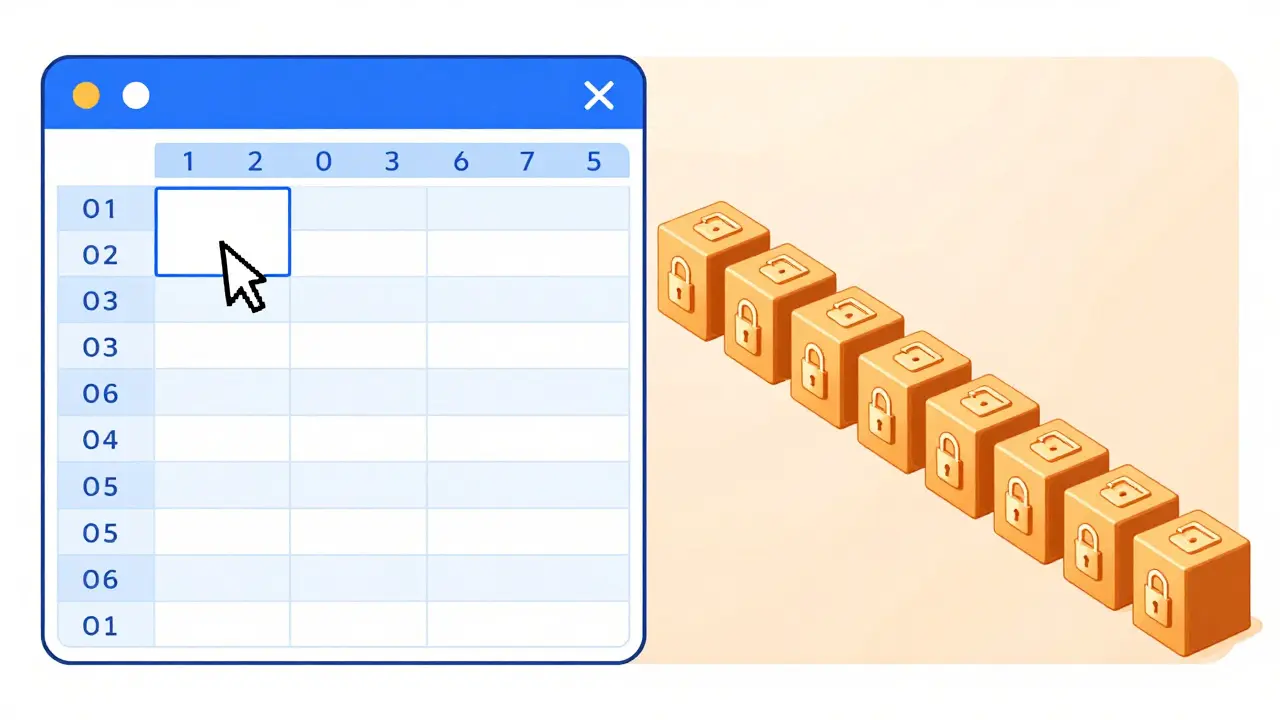
If you’ve ever used Excel, you already understand traditional databases. They rely on structured schemas-rows and columns. This structure makes them incredibly efficient for searching and sorting. Want to find all customers named "John" who bought shoes last Tuesday? A relational database uses indexes to pull that up in milliseconds. It supports CRUD operations: Create, Read, Update, Delete. If you make a typo in a customer’s address, you just hit "update." Done.
Blockchain doesn’t work like a spreadsheet. It works like a receipt tape that never ends. Data is grouped into blocks, which are chained together chronologically using cryptographic hashes. Once a block is added to the chain, it is mathematically locked. You cannot edit it. You cannot delete it. If you need to correct an error, you have to add a new transaction that reverses or overrides the old one. This immutability is fantastic for audit trails but terrible for simple tasks like fixing a typo in a user profile.
| Feature | Traditional Database | Blockchain |
|---|---|---|
| Data Model | Relational (Tables/Rows) | Sequential Blocks & Hashes |
| Modifiability | Mutable (Edit/Delete allowed) | Immutable (Append-only) |
| Control | Centralized (Admin controlled) | Decentralized (Network consensus) |
| Query Complexity | High (SQL joins, filters) | Low (Basic transaction lookup) |
Performance: Why Blockchains Are Slow
Let’s talk numbers, because this is where most projects fail. A modern traditional database, like PostgreSQL or MySQL, can handle tens of thousands of transactions per second (TPS). When you buy coffee with a card, the bank’s backend processes that in fractions of a second. It’s fast because only one server needs to verify and record the transaction.
Public blockchains are sluggish by comparison. Bitcoin might handle 7 TPS. Ethereum, even after upgrades, struggles to reach hundreds without relying on secondary layers. Why? Because every node in the network must download, verify, and store every single transaction. Imagine trying to update a shared Google Doc where everyone has to print out the whole document, sign their name on the page, and mail it back before the next person can write anything. That’s the latency cost of decentralization. For applications requiring real-time data processing, like high-frequency trading or live gaming leaderboards, public blockchain is currently a non-starter.
Security: Centralized Fortresses vs. Distributed Nets
Traditional databases are secure, but they have a single point of failure. If hackers breach the main server, they potentially have access to everything. We’ve seen massive data breaches where millions of user records were stolen because the central vault was picked. Security here relies on firewalls, encryption at rest, and strict access controls managed by humans.
Blockchain security is mathematical. Because the data is distributed across thousands of nodes, an attacker would need to compromise more than 51% of the entire network’s computing power to alter the ledger-a feat that is economically and practically impossible for major networks. Additionally, every block contains a cryptographic hash of the previous one. Change one character in a past transaction, and the hash changes, breaking the chain and alerting the entire network immediately. However, remember: blockchain secures the *ledger*, not necessarily the code running on top of it. Smart contract bugs still lead to billions in losses, proving that decentralization doesn’t equal invincibility.
Cost Implications: Hidden Fees vs. Infrastructure
When people hear "decentralized," they assume it’s cheaper because there’s no middleman. In practice, it’s often the opposite. Running a traditional database requires server costs, electricity, and salaries for DBAs. These are predictable operational expenses (OpEx).
Blockchain introduces variable costs. On public networks, you pay "gas fees" or transaction fees to validators for every write operation. During peak times, these fees can skyrocket. Furthermore, storing data on-chain is expensive. Storing a large image or video file directly on a blockchain is prohibitively costly. Most systems store only a hash (a fingerprint) of the file on-chain and keep the actual file off-chain in cheaper storage. Traditional databases allow you to store petabytes of data for a fraction of the cost.
When to Use Which: Practical Scenarios
So, how do you decide? Here is a quick mental checklist based on real-world use cases.
Use a Traditional Database when:
- You need frequent updates (e.g., inventory levels, user profiles).
- You require complex queries (e.g., financial reporting, analytics dashboards).
- Privacy is critical (you don’t want your competitors seeing your sales data).
- You need high throughput and low latency (e.g., e-commerce checkout, social media feeds).
Use Blockchain when:
- You need a shared source of truth among untrusted parties (e.g., supply chain tracking between manufacturers and retailers).
- Immutability is legally required (e.g., land registries, academic credentials).
- You are issuing digital assets or tokens (e.g., cryptocurrencies, NFTs, loyalty points).
- You want to eliminate intermediary fees in cross-border payments.
The Hybrid Future
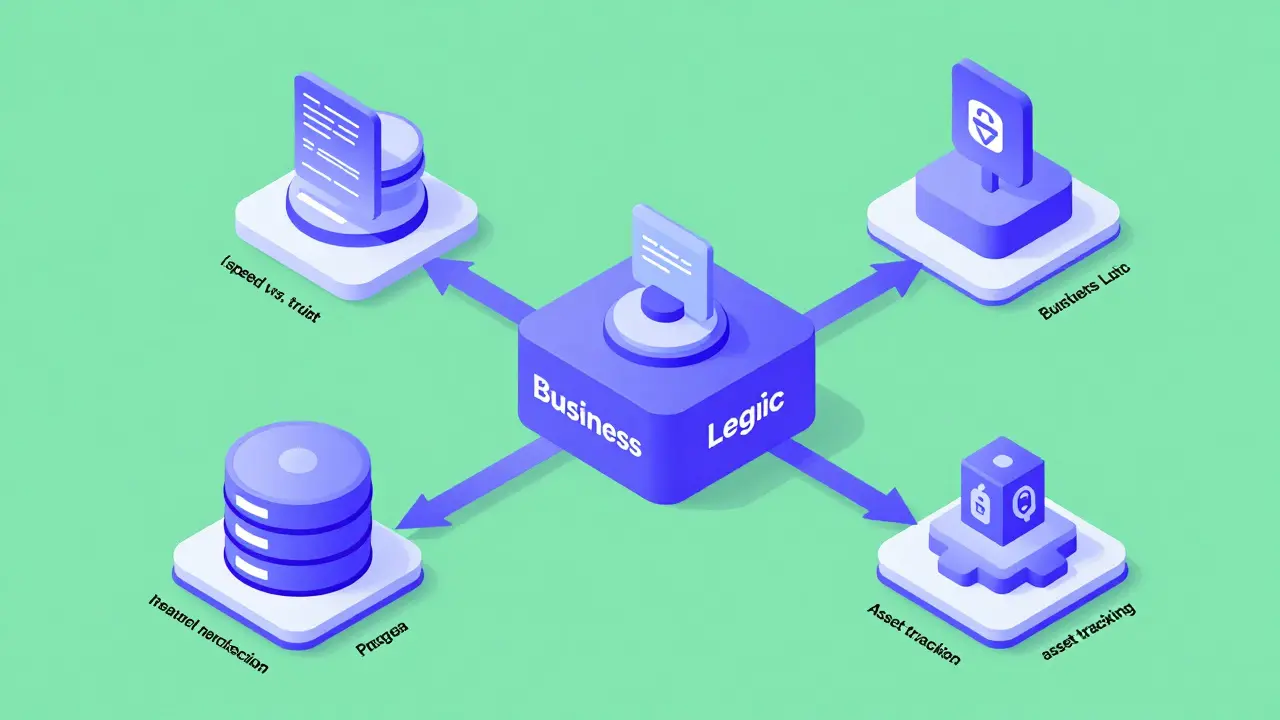
We aren’t seeing a replacement; we’re seeing integration. Many enterprises now use hybrid architectures. They keep their core business logic and sensitive customer data in traditional SQL databases for speed and privacy. Then, they use a private or consortium blockchain to record specific events-like a signed contract or a shipped product-that need to be verified by external partners. This gives you the best of both worlds: the efficiency of centralized storage and the trust of decentralized verification.
Don’t fall into the trap of using blockchain as a buzzword solution. If you can solve your problem with a standard database, do it. It will be faster, cheaper, and easier to maintain. Save the blockchain for the problems that actually require a trustless, immutable ledger. Otherwise, you’re just adding unnecessary complexity to your stack.
Can blockchain replace traditional databases entirely?
No. Blockchain lacks the query capabilities, speed, and cost-efficiency of traditional databases for general-purpose data storage. It is best suited for specific use cases requiring immutability and decentralization, while traditional databases remain superior for high-performance, complex data management.
Is blockchain more secure than a traditional database?
It depends on the threat model. Blockchain is more resistant to data tampering and single-point-of-failure attacks due to its distributed nature. However, traditional databases offer better control over privacy and access rights. Blockchain also exposes all data publicly on many networks, which can be a security risk for sensitive information.
Why are blockchain transactions so slow?
Slowness is caused by the consensus mechanism. Every transaction must be verified by multiple independent nodes across the network rather than a single central server. This distributed validation process ensures security and agreement but significantly increases latency compared to centralized databases.
What is the cost difference between storing data on blockchain vs. traditional databases?
Storing data on public blockchains is exponentially more expensive due to gas fees and the need to replicate data across thousands of nodes. Traditional databases are highly optimized for storage density and cost, making them far more economical for large-scale data retention.
Can I use both blockchain and traditional databases in one application?
Yes, this is a common hybrid approach. Applications often use traditional databases for internal operations, user data, and fast queries, while using blockchain to record critical, verifiable events or asset transfers that require transparency and immutability for external stakeholders.
20 Comments
pretty solid breakdown honestly. i think a lot of people still get hung up on the hype without looking at the actual use cases.
i dont get why everyone thinks blockchain is magic. its just slow and expensive for most things. sql is king fr
You're ignoring the fact that enterprise solutions are moving toward hybrid models because pure SQL doesn't solve trust issues between competing entities. The article actually addresses this, so read it again if you missed that part.
Look, I’m not saying SQL is bad, but let’s be real about the 'trust' aspect. If you’re dealing with supply chains or cross-border payments where parties don’t like each other, a central DB is a nightmare. You need that immutable ledger to stop the finger-pointing. It’s messy, sure, but sometimes you gotta pay the latency tax for peace of mind. Plus, the whole 'consensus' thing is kinda beautiful in a chaotic way, like a digital democracy that actually works.
I totally see what you mean about the trust factor. It’s definitely a niche tool, but when you need that level of verification, nothing else really cuts it.
yeah i feel u on the slowness tho. trying to run a high traffic app on public chain is a headache. gas fees alone will kill ya.
Stop complaining about gas fees and start optimizing your code! If you can’t handle the cost, maybe you shouldn’t be using a decentralized network for trivial data storage. This isn’t a database replacement; it’s a security protocol. Wake up!
hey now lets keep it chill. lorna has a point though, optimization matters. but yeah storing images on chain is stupid. use ipfs or aws for that stuff.
The entire premise of this discussion is flawed because you are treating blockchain as a technological solution rather than a sociological one. Traditional databases are built on the assumption of benevolent administrators, which is a fantasy in a corrupt world. Blockchain exposes the inherent selfishness of human actors by forcing them to compete for validation. It is ugly, inefficient, and expensive precisely because it reflects the true cost of distrust in society. You should be ashamed for suggesting SQL for anything involving public record keeping. It is morally bankrupt.
Oh my gosh, wow. That was intense! I just wanted to say that both have their place. Sometimes you just want a quick fix and sometimes you need something super secure. It’s all about balance, right? Like, we don’t need to fight over it. Technology is cool no matter what form it takes. Let’s just appreciate the progress we’ve made together.
Listen up, team! We need to stop bickering and start building. Whether you love SQL or hate it, you need to understand how they interact. The future is hybrid. Get your head out of the sand and learn both stacks. If you can’t query a relational DB and deploy a smart contract, you’re already obsolete. Step up your game!
Great points Craig! 🚀 I’ve found that understanding the underlying architecture helps a ton. Don’t forget that Layer 2 solutions are changing the speed game significantly too. Keep learning and stay curious! 🧠✨
The philosophical implication here is interesting. We are essentially choosing between efficiency through hierarchy and security through redundancy. It mirrors broader societal structures. I find myself leaning towards the idea that decentralization is an inevitable evolution, even if the current implementation is clunky. It forces us to rethink authority itself.
I have to say that while the technical details are fascinating, what really gets me excited is the potential for democratizing access to financial services and transparent governance structures, which I believe will ultimately lead to a more equitable global society where individuals have greater control over their own data and assets, thereby reducing the power imbalance that currently exists between large corporations and everyday consumers, and I think that is a really positive step forward for humanity.
man, i just wish devs would stop trying to put everything on the blockchain. it’s not a silver bullet. keep it simple.
Actually, the reason developers misuse blockchain is due to a fundamental lack of understanding regarding cryptographic primitives and consensus mechanisms. They treat it like a NoSQL database with extra steps. It is pathetic to see such basic architectural errors being touted as innovation. Read a textbook before you comment.
I think we can all agree that clarity is key here. It’s important to define the problem first before picking the tool. I’ve seen some great projects that use both effectively, so let’s try to focus on those success stories instead of tearing each other down.
How utterly pedestrian. The notion that one might simply 'choose' between these technologies suggests a superficial grasp of systemic design. True engineering elegance lies in recognizing that blockchain is often a solution in search of a problem, much like most American tech trends. One must possess a certain cultural sophistication to appreciate that centralized control, when wielded by competent hands, is far superior to the chaotic inefficiency of distributed nonsense.
I completely understand where you are coming from, Barclay, and it is quite intriguing how cultural perspectives shape our views on technology, especially when we consider that in many parts of the world, trust in central institutions is incredibly low, which makes the appeal of decentralized systems much stronger for people who have experienced corruption or lack of transparency in their local governments, and perhaps we could explore how different cultural backgrounds influence our acceptance of these new technologies in a more nuanced way that respects diverse viewpoints.
It is imperative that we recognize the strategic necessity of sovereign control over data infrastructure. The reliance on foreign-ledger protocols introduces unacceptable vectors for adversarial exploitation. We must prioritize domestic computational sovereignty and ensure that critical state functions remain within the jurisdictional purview of national authorities, thereby mitigating the risk of external manipulation via decentralized consensus mechanisms that lack adequate regulatory oversight.