
Blockchain-Based Identity Verification: How It Works and Why It’s Changing Digital Trust
Identity Verification Cost Calculator
Enter Your Current Verification Details
Estimated Blockchain Verification Details
Based on industry data: Blockchain verification typically takes 1-5 minutes and costs $5-$10 per verification.
Annual Cost Comparison
Current system: $0.00
Blockchain system: $0.00
Time Savings
Current time: 0 hours
Blockchain time: 0 hours
Annual Savings: $0.00 | 0 hours saved
What is blockchain-based identity verification?
Imagine being able to prove who you are online without handing over your passport, driver’s license, or Social Security number every time you log in, open a bank account, or apply for a job. That’s what blockchain-based identity verification promises - and it’s already happening in banks, hospitals, and government services around the world.
Unlike traditional systems where your identity data is stored in a company’s or government’s database, blockchain-based identity puts you in control. Your personal information isn’t stored on a central server. Instead, encrypted references to your documents are saved on a blockchain, while the actual files live in secure, decentralized storage like IPFS. You keep the keys. No one else can access your data unless you say so.
How it actually works (step by step)
Here’s how it works in practice:
- You download a verified identity app - like those from IBM, Dock.io, or Civic.
- You upload your government-issued ID (passport, driver’s license) to a secure off-chain storage system (IPFS).
- The app generates a unique cryptographic hash of your document and records that hash on the blockchain. This hash acts as a tamper-proof fingerprint.
- You create a pair of cryptographic keys: a private key (only you have it) and a public key (shared with services that need to verify you).
- When you need to prove your identity - say, to open a bank account - you use your app to share only the specific data required. Maybe just your age, not your full birthdate. Maybe your professional license, not your address.
- The service checks the hash on the blockchain to confirm the data hasn’t been altered. It uses your public key to verify your digital signature. All of this happens in seconds.
No more uploading the same documents to five different websites. No more waiting days for manual reviews. No more data breaches exposing your entire identity.
Why blockchain beats traditional systems
Traditional identity systems are broken. They rely on centralized databases - one password, one breach, and your whole identity can be stolen. In 2023 alone, over 1.2 billion records were exposed in identity-related data breaches, according to IBM’s Cost of a Data Breach Report.
Blockchain fixes this by removing the central point of failure. Even if one node in the network is compromised, the rest keep the data intact. Your identity isn’t stored in one place - it’s verified across many.
And it’s not just about security. It’s about control. In traditional systems, your identity belongs to the bank, the employer, the government. With blockchain, you own it. You decide who sees what. You can revoke access anytime.
Zero-knowledge proofs make this even smarter. You can prove you’re over 21 without revealing your birthdate. Prove you have a medical license without showing your license number. Prove you’re a citizen without handing over your passport. This level of privacy was impossible before.
Real-world use cases
This isn’t theoretical. It’s live.
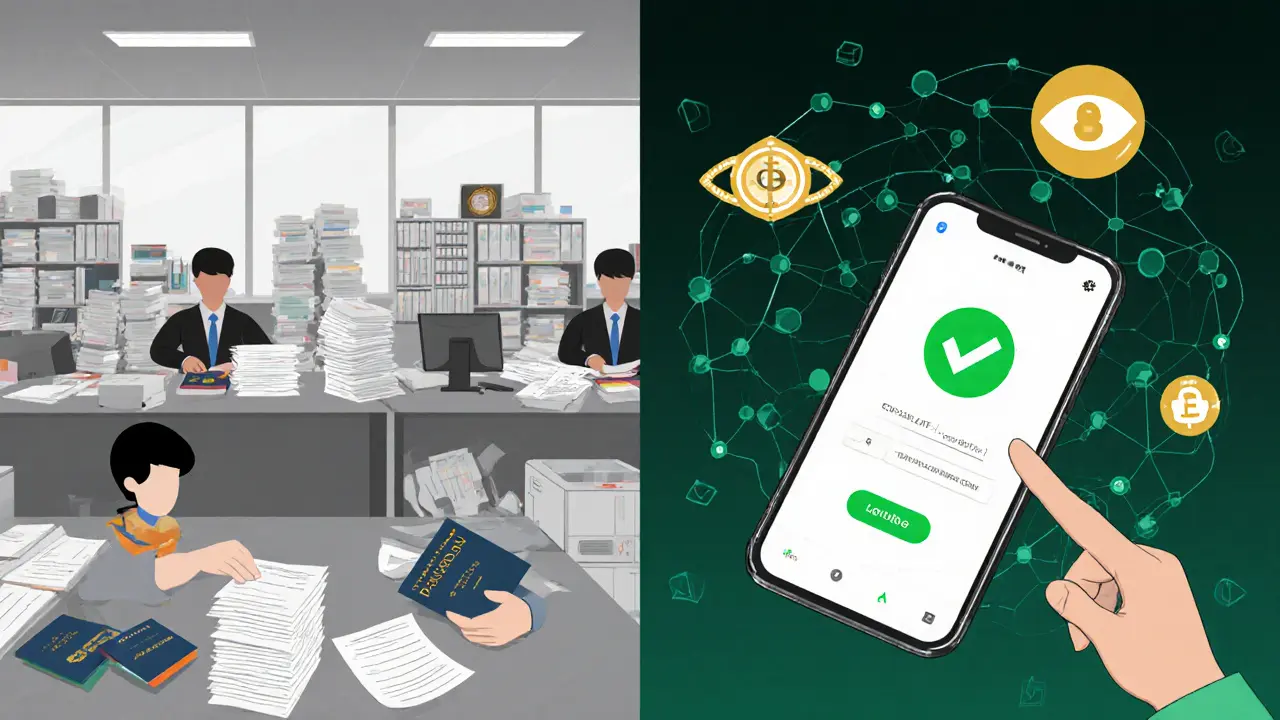
- Financial services: Banks in the EU and Canada now use blockchain identity to onboard customers in under 5 minutes. One bank reduced KYC (Know Your Customer) time from 45 minutes to 90 seconds.
- Healthcare: Hospitals in New Zealand and Australia are testing blockchain IDs to securely share patient records between clinics. Patients control who accesses their medical history.
- Government: Estonia has been using blockchain for citizen identity since 2014. In a 2022 pilot, 87% of users said they felt more in control of their data than with the old system.
- Employment: Professionals in tech and finance use blockchain-based credentials to prove certifications, degrees, and work history to employers without sharing transcripts or HR files.
One healthcare provider reported cutting patient onboarding time from 45 minutes to under 5 minutes - just by switching to blockchain verification. That’s not a small win. That’s life-changing for patients and staff alike.
Challenges you won’t hear about in marketing brochures
Yes, it’s powerful. But it’s not magic.
The biggest hurdle? Key management. If you lose your private key, you lose your identity. There’s no ‘forgot password?’ button. Recovery systems exist - like multi-sig backups or social recovery - but they’re complex. In a PreciseHire survey, 28% of enterprise users cited key management as their top challenge.
Another issue: integration. Most companies still run legacy systems from the 1990s. Connecting those to blockchain requires serious engineering. IBM estimates full enterprise deployment takes 8-12 weeks and requires 40+ hours of blockchain training for IT staff.
Then there’s regulation. GDPR in Europe allows you to delete data - but blockchain is immutable. How do you comply? Solutions now use off-chain storage with revocable credentials, but it’s still a legal gray area in many countries.
And adoption. You can have the best tech in the world, but if people don’t trust it or find it too hard to use, it won’t stick. Reddit users report mixed experiences: one called it ‘seamless’; another said managing keys was ‘steeper than expected.’
Who’s building this and what’s new in 2025?
Big players are all in. IBM, Microsoft (ION), and Consensys have been developing blockchain identity tools for years. But newer companies like 1Kosmos and Dock.io are pushing boundaries.
In 2023, Dock.io launched biometric-bound credentials - meaning your facial scan or fingerprint is tied to your digital ID. You can’t just share a credential; you have to be physically present to use it. That’s a big step against identity theft.
IBM partnered with U.S. state governments to integrate mobile driver’s licenses (mDL) into blockchain systems. Now, your phone can act as your official ID at airports, bars, and DMVs.
The W3C Verifiable Credentials Data Model 2.0, finalized in early 2023, means different systems can now talk to each other. Your identity from one platform can be accepted by another - no more silos.
By 2025, most providers plan to integrate with DeFi apps. Imagine borrowing crypto without collateral - just prove your identity and credit history on-chain.
What’s the future look like?
Market research firm MarketsandMarkets projects the blockchain identity market will grow from $1.84 billion in 2023 to $17.24 billion by 2030. That’s a 38.2% annual growth rate.
Gartner predicted in 2022 that by 2025, half of all organizations will start using decentralized identity for customer access. That’s not a guess - it’s a roadmap.
By 2027, Forrester expects blockchain-based identity to handle 30% of digital identity transactions in developed economies. That means when you log into your bank, file taxes, or book a flight, you’ll likely use your blockchain ID - not a password or security question.
It won’t replace all systems overnight. But it’s becoming the new standard for high-stakes, high-security interactions. And for anyone tired of being a data commodity, it’s the first real alternative.
Is it right for you?
If you’re a regular user: You don’t need to do anything yet. But when your bank or employer asks you to set up a digital identity wallet, it’s worth it. It’s faster, safer, and gives you back control.
If you’re a business owner: Start exploring. The cost of data breaches, manual verification, and compliance fines is rising. Blockchain identity cuts those costs by 40-60% in many cases.
If you’re a developer: Learn about DIDs (decentralized identifiers), verifiable credentials, and smart contracts. This is the next wave of web infrastructure - and you’ll be building it.
Can I really own my identity with blockchain?
Yes. With blockchain-based identity, you hold the private keys that unlock access to your verified data. No company, government, or service provider can access or alter your information without your permission. You decide who sees what - and when. This is called self-sovereign identity, and it’s the core promise of the system.
What happens if I lose my private key?
Losing your private key means losing access to your digital identity - there’s no central authority to reset it. That’s why most systems now offer recovery options: multi-sig wallets (requiring 2-3 trusted contacts to approve recovery), social recovery (asking friends to verify your identity), or encrypted backups stored on secure devices. But you must set these up during onboarding. Don’t skip them.
Is blockchain identity legal?
In many places, yes. The European Union’s eIDAS 2.0 framework explicitly recognizes blockchain-based digital identities as legally valid. Canada, Japan, and parts of Australia also accept them. In the U.S., several states now recognize mobile driver’s licenses tied to blockchain. However, regulations vary. Always check local laws before relying on it for official purposes like banking or voting.
Does blockchain identity work without internet?
Most blockchain identity apps require internet to verify credentials, since they need to check the blockchain or IPFS. However, some systems allow offline verification using locally stored cryptographic proofs - for example, showing a QR code that a scanner can validate without connecting to the network. This is useful in remote areas or during outages, but it’s still limited.
How is this different from a digital wallet like Apple Wallet?
Apple Wallet stores your ID as a digital copy - but it’s still controlled by Apple. Your data is stored on their servers, and they decide what apps can access it. Blockchain identity gives you full control. You own the keys, the data stays off-chain, and you choose who gets access. It’s not about where you store it - it’s about who controls it.
Can blockchain identity be hacked?
The blockchain itself is nearly impossible to hack - it’s distributed and cryptographically secured. But the app on your phone? That can be compromised if your device is infected with malware. The biggest risk isn’t the blockchain - it’s your phone’s security. Always use strong passwords, biometric locks, and avoid sideloading apps. Your private key is only as safe as your device.
Will this replace passwords forever?
It’s already replacing them in many high-security areas - banking, government services, healthcare. For everyday logins, passwords aren’t going away overnight. But as more services adopt blockchain ID, you’ll find yourself using it more often. Eventually, passwords will become the exception, not the rule.
15 Comments
So basically, we’re trading one set of corporate overlords for a bunch of crypto bros who think losing your key is a life lesson. Cool.
I’ve used this system to open a bank account in 90 seconds-no forms, no scans, no ‘please verify your mother’s maiden name.’ I felt like a superhero. This isn’t the future-it’s the *now*. Stop waiting for permission to take control of your data.
The math doesn't add up blockchain is immutable so gdpr compliance is impossible unless you use off chain storage which defeats the purpose of decentralization and then you have central points of failure again so really this is just marketing fluff wrapped in crypto jargon
I tried it last month for my freelance gig. Super easy to share my tax ID without giving them my whole passport. But when my phone died and I forgot to back up my key? Yeah... I cried. Not fun.
You people are naive. Blockchain identity sounds great until you realize it’s just another way for governments and corporations to track you more efficiently. They don’t want you to own your identity-they want you to think you do. This is surveillance with a blockchain sticker on it.
Guys, I’ve helped 3 friends set this up and all of them are now saying 'why didn’t we do this sooner?' The key recovery thing is tricky but once you get it, it’s smooth sailing. Use social recovery, don’t be lazy. 💪🔐
Ah yes, the existential liberation of self-sovereign identity... a beautiful dialectical negation of the capitalist subject’s alienation through cryptographic ontology. But honestly, if I lose my key, am I just... erased? Like, ontologically? 🤔
I work in healthcare IT and we just rolled this out for patient access. The difference? Nurses used to spend 20 mins verifying identity. Now it’s 30 seconds. Patients are happier. Staff are happier. Everyone wins. 🙌
I’ve been in tech since the dot-com days. This is the first time I’ve seen something that actually *reverses* power dynamics instead of just monetizing them. It’s not perfect, but it’s the first real step toward digital dignity. Don’t sleep on it.
Used it for my visa application. Took 5 minutes. No emails back and forth. No PDF uploads. Just scanned my face, tapped approve, and done. Life’s too short for paperwork.
While the theoretical underpinnings of decentralized identity are commendable, the operational feasibility remains constrained by infrastructural heterogeneity, user literacy deficits, and regulatory non-conformity across jurisdictions.
Let me guess-this is the same tech the CIA uses to track dissidents under the guise of 'privacy.' They want you to think you’re free so you hand over your biometrics willingly. Wake up. This is a Trojan horse with a blockchain logo.
I lost my key last week. I panicked. Then I used the social recovery thing with my 3 friends. Took 3 days but it worked. Honestly? Kinda cool having friends help you not get locked out of your own life.
So you're saying if I lose my key, I lose my identity... but if a corporation loses its database, I lose my identity? So... we're just swapping one risk for another? And you're excited about this?
I’m a small business owner in Mumbai and we started using this for hiring. We got a guy from Lagos who proved his degree, work history, and even his LinkedIn endorsements-all verified, no emails, no waiting. He got hired in 2 hours. Tech isn’t magic, but this? This feels like progress.