
Bittime Crypto Exchange Review 2026: Risks, Rewards, and Real Security Gaps

When you hear "Bittime crypto exchange," you might think of high staking yields, easy access to Asian markets, or a platform that doesn’t ask too many questions. But if you’re thinking about depositing real money there, you need to know the truth behind the marketing. Bittime isn’t a scam - but it’s not safe either. It’s a middle-ground platform that works for some, but puts your assets at risk in ways most users don’t even realize.
What Bittime Actually Offers
Bittime is a cryptocurrency exchange built for traders in Southeast Asia, especially Indonesia. It lets you buy, sell, and stake crypto like Bitcoin, Ethereum, and a bunch of smaller coins. The big draw? Staking yields. Some assets pay over 12% annually. That’s way higher than what Kraken or Coinbase offer. If you’re chasing returns and don’t mind taking risks, that’s tempting.
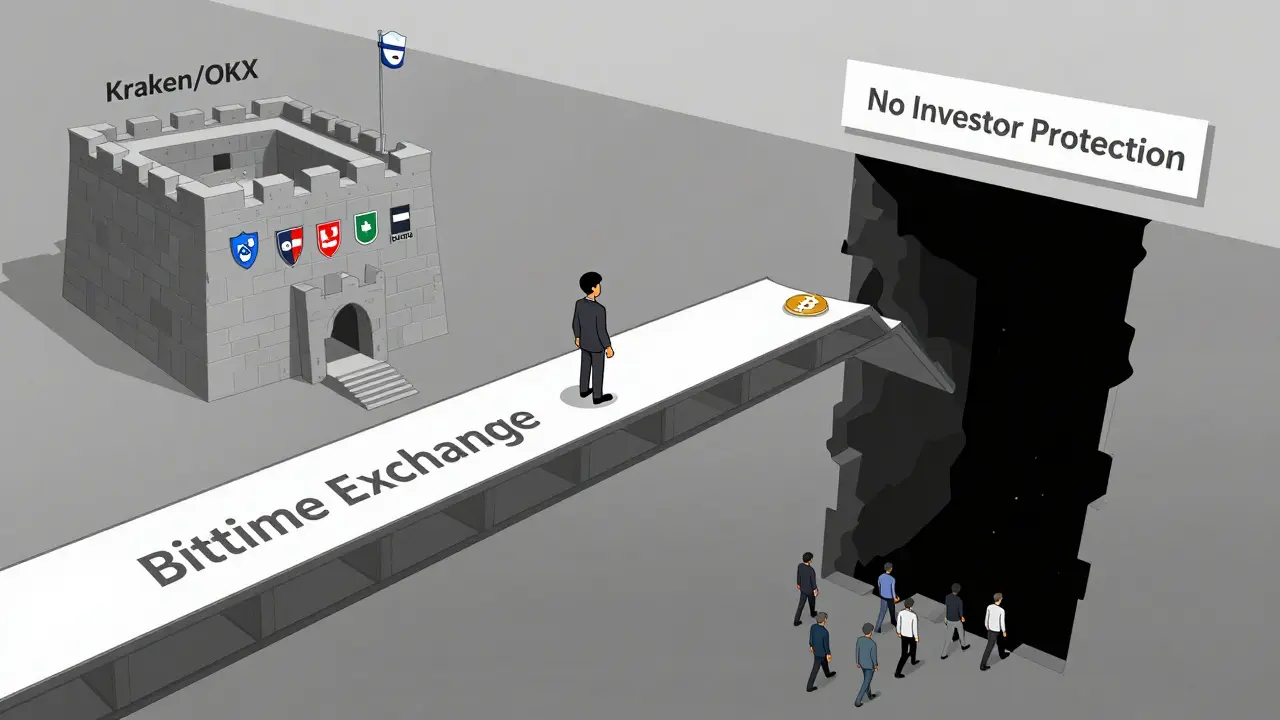
But here’s the catch: Bittime doesn’t play by the same rules as exchanges in the U.S., Europe, or Australia. It’s regulated under Indonesian law - not by the SEC, FCA, or ASIC. That means no investor protection fund. If Bittime goes down, you won’t get your money back. Period. Unlike Kraken, which is licensed in multiple Tier-1 jurisdictions, Bittime’s regulatory score is 0.0 according to CoinGecko’s system. That’s not a typo.
The Security Problem You Can’t Ignore
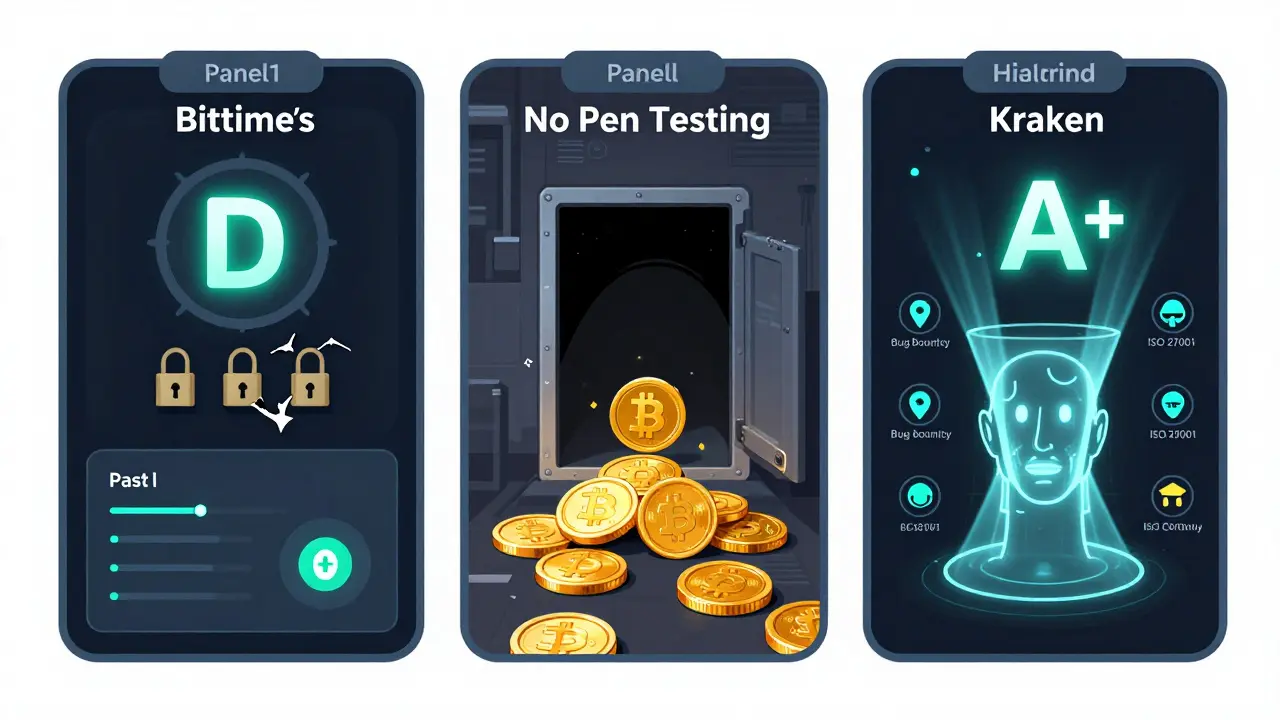
Bittime claims it’s never been hacked. That sounds good - until you look at the numbers. CER.live, a cybersecurity research group, gave Bittime a 17% security score and a "D" rating. Why? Because they found zero penetration testing, no bug bounty program, and no public audit history. Those aren’t optional extras - they’re basic industry standards. Even smaller exchanges do these things.
They also don’t use facial recognition. Some users like that - it feels private. But for security? It’s a red flag. OKX and Kraken use it because it adds a layer that simple 2FA can’t match. Bittime only offers two-factor authentication and cold wallet storage. Cold wallets are great, but if the exchange’s hot wallets get breached, your funds are still at risk. And without ongoing security checks, there’s no way to know if they’re really safe.
CoinGecko’s Trust Score is 6/10 - right in the middle. But look closer: their cybersecurity component scored 0.0. That’s not a mistake. It means Bittime fails the most important part of exchange safety. Your trading volume might be high, but if the platform can’t protect your assets, what’s the point?
Who Uses Bittime - And Why
Bittime has about 1.2 million users. Almost 80% are in Indonesia. That’s not random. The platform tailored itself to local regulations and banking systems. It partnered with Jenius, an Indonesian digital bank, to make fiat deposits easier. For people living there, that’s a big advantage. Local regulation means fewer surprises, and fewer freezes on withdrawals.
But outside Indonesia? It’s a different story. The platform pulled out of Europe in 2024 because it couldn’t meet MiCA rules. It doesn’t serve U.S. customers at all. That tells you something: Bittime chose markets with looser rules. That’s not a strength - it’s a compromise.
The user base is mostly intermediate traders (58%) and people chasing staking rewards (32%). Only 10% are institutions. That’s a red flag. If professional firms won’t use it, why should you? You’re not just trusting a platform - you’re trusting its weakest users.
KYC: Too Much or Just Enough?
Bittime requires full KYC - government ID, proof of address, sometimes video verification. Some users complain it takes up to 72 hours. That’s slow. Other exchanges like Binance or Coinbase do it in under 24 hours. But for users in Indonesia, this isn’t a complaint - it’s a comfort. They see it as proof the platform is legit and following local laws.
Still, the process is rigid. If your documents don’t match perfectly, you get stuck. There’s no chatbot, no quick fix. You’re stuck waiting for a human to review it. And if you’re outside Indonesia? You might get rejected outright. Bittime doesn’t make it easy for global users.
Trading Experience and Support
The interface is clean but not beginner-friendly. It doesn’t have tutorials, video guides, or a simple "buy crypto" button like Robinhood or Cash App. If you’re new, you’ll need 3 to 5 hours just to figure out how to place an order. The API documentation is excellent - graded "A" by CoinGecko - but that’s for developers, not regular users.
Customer support works 24/7. Email replies take about 2 hours. Live chat hits 15 minutes. That’s better than most mid-tier exchanges. But support can’t fix security flaws. If your account gets drained because of a vulnerability they never patched, no customer rep is going to help.
What Bittime Is Planning - And Why It Matters
Bittime says it’s working on fixes. By Q3 2025, it plans to get ISO 27001 certified. That’s a global security standard. By Q4, it’ll add facial recognition. That’s good news - if it happens. But these are promises made in February 2025. Nothing’s been delivered yet.
Here’s the problem: security isn’t something you can patch later. It’s built in from day one. A platform that’s been running for years without penetration testing or a bug bounty program doesn’t suddenly become safe because it says it will try. The damage - if it happens - is already done.
Real Talk: Should You Use Bittime?
Let’s cut through the noise.
- If you’re in Indonesia and want to stake crypto with decent yields - and you’re okay with limited protections - Bittime works. It’s one of the few regulated options there.
- If you’re anywhere else, especially in the U.S., EU, or Australia - don’t use it. You’re not getting better yields. You’re just taking more risk.
- If you’re holding more than a few hundred dollars - keep it off Bittime. Use a wallet you control. Or pick an exchange with Tier-1 regulation.
- If you’re chasing 12% APY - ask yourself: what’s the real cost? Are you paying with your security?
There’s no such thing as free money in crypto. High yields always come with hidden trade-offs. Bittime’s trade-off? You’re betting your assets on a platform that’s built to avoid global standards - not meet them.
Final Verdict
Bittime isn’t dangerous. It’s just unprepared. It’s a platform designed for a specific market, with specific rules, and specific risks. It’s not evil. But it’s not safe either.
Use it if you live in Indonesia and understand the trade-offs. Don’t use it if you want your crypto to be as secure as possible. Because in crypto, safety isn’t optional - it’s the only thing that matters.
Is Bittime a scam?
No, Bittime isn’t a scam. It’s a real exchange that operates legally under Indonesian regulation. Users can deposit, trade, and withdraw funds. However, it lacks key security features and regulatory protections found on top-tier exchanges. That doesn’t make it fraudulent - but it does make it risky.
Can I trust Bittime with my Bitcoin?
Only if you’re okay with losing it. Bittime stores assets in cold wallets, which is good. But it doesn’t do penetration testing, doesn’t have a bug bounty program, and scored 0.0 on cybersecurity metrics. If a hacker finds a vulnerability - and history shows they will - your Bitcoin could vanish. For long-term storage, use a hardware wallet instead.
Why does Bittime have such high staking yields?
High yields come from lower security costs and fewer regulatory overheads. Bittime doesn’t spend money on global compliance, investor protection funds, or advanced security audits. That saves them money - and lets them pass some of those savings to users as staking rewards. But you’re essentially being paid to take on more risk.
Is Bittime available in the U.S.?
No. Bittime explicitly does not serve U.S. customers. It exited the European market in 2024 to avoid MiCA regulations. If you’re in the U.S., you won’t be able to sign up - and if you somehow do, your account will likely be frozen or closed.
How does Bittime compare to Kraken or OKX?
Kraken and OKX are regulated in multiple Tier-1 jurisdictions, have active bug bounty programs, and undergo regular security audits. Bittime has none of that. It offers better staking yields, but at the cost of safety. If security matters, Kraken and OKX are far superior. If you’re only looking for yield and live in Indonesia, Bittime might be your only viable local option.
What’s the minimum amount to stake on Bittime?
Most assets require a minimum of 0.1 BTC or its equivalent in other cryptocurrencies. For smaller tokens, the minimum is often around $100 USD value. Always check the current requirements on Bittime’s staking page - they change frequently.
Does Bittime have a mobile app?
Yes, Bittime has native apps for iOS and Android. The app mirrors the web platform’s interface and features. However, user reviews note occasional crashes and slow loading times, especially during high-volume periods. Security features like 2FA work on the app, but facial recognition is not yet available.
Can I withdraw fiat currency from Bittime?
Only if you’re in Indonesia. Bittime allows fiat withdrawals via local bank transfer to Indonesian accounts through its partnership with Jenius. Users outside Indonesia cannot withdraw fiat - only crypto. If you’re not in Indonesia, you’ll need to sell your crypto on Bittime and send it to another exchange to cash out.
What to Do Next
If you’re already on Bittime and have funds there, move them. Not all at once - but start. Transfer your Bitcoin or Ethereum to a wallet you control. Use a hardware wallet like Ledger or Trezor. If you’re still staking, pause it. Those 12% yields aren’t worth the risk.
If you’re thinking about signing up - don’t. Find an exchange with real regulation, active security audits, and global support. Bittime fills a niche. But that niche is for people who are okay with gambling on security - not for anyone serious about protecting their crypto.
17 Comments
Bittime is a trap. 12% APY? That’s just the bait. No bug bounty, no audits, no facial recognition. You think you’re earning passive income but you’re really just handing your keys to a house with no locks. If your crypto vanishes, you won’t even get a refund email. Just silence.
Let’s be precise: Bittime’s cybersecurity score is 0.0 because they’ve never conducted a single penetration test. That’s not negligence-it’s structural. The entire model relies on regulatory arbitrage. They exploit jurisdictions with weak oversight to offer unsustainable yields. This isn’t finance-it’s behavioral economics engineered for risk-seeking amateurs.
Compare that to Kraken’s ISO 27001 compliance and multi-layered threat modeling. Bittime doesn’t just lag behind-they’re operating in a different universe. If you’re not a resident of Indonesia with zero alternatives, you’re not investing. You’re gambling.
Look I get it you’re all up in arms about security but honestly who cares if you’re just holding shitcoins anyway I mean if you’re so worried about your Bitcoin why are you even on an exchange in the first place why not just hodl in a cold wallet like a real degenerate
Also the fact that people think facial recognition is some kind of security godsend is hilarious it’s literally just biometric login not a blockchain fortress
And 12% APY is nothing when you consider how much money Bittime saves by not hiring compliance officers or doing audits that’s just smart business not a scam
Also why are we even talking about this like it’s a global issue it’s an Indonesian platform for Indonesians stop trying to universalize everything
I’ve used Bittime for a year now. I live in Indonesia. I know the risks. I’ve lost money before on other platforms. This one? At least I can withdraw. At least I know who’s behind it. The KYC takes three days? Fine. I’d rather wait than get locked out forever like on some offshore platform.
People outside Indonesia don’t get it. You think regulation = safety? Not always. Sometimes it just means more paperwork and less access. Bittime isn’t perfect. But for us? It’s the best option we’ve got.
And yes, I know the security score is low. But I also know they’re working on fixes. They’re not ignoring it. They’re building. Maybe slowly. But they’re trying.
There’s a reason Bittime doesn’t serve the U.S. or EU. It’s not because they’re evil. It’s because they’re honest. They didn’t try to game the system. They didn’t pretend to be something they’re not. They built a platform for a market that’s been ignored. And now people from rich countries are mad because they can’t play?
Stop projecting your fears onto others. If you’re not in Indonesia, don’t use it. Simple. But if you are? Stop listening to fearmongers who’ve never even tried to deposit a single token.
Security isn’t just audits and certifications. It’s also reliability. Bittime has never frozen withdrawals. It’s never disappeared. It’s been slow. But it’s been there.
As someone from Jakarta, I can say Bittime changed my life. Before this, I had to use unregulated P2P traders. Now I have a clean interface, real support, and I can stake my ETH without worrying about a random Telegram group disappearing with my money.
Yes, the security isn’t perfect. But it’s better than what we had. And the fact that they’re planning ISO 27001? That’s huge for us. We don’t need Kraken. We need something that works here.
Stop judging from afar. You don’t know what it’s like to live where banking is unreliable and crypto is the only real alternative.
12% is not free money its the cost of doing business without global oversight
There’s a cultural blind spot here. People in the U.S. and EU treat crypto like a financial product. In places like Indonesia, it’s a lifeline. Bittime isn’t trying to be Coinbase. It’s trying to be the bridge between a fragmented banking system and a growing digital economy.
Calling it unsafe because it lacks facial recognition misses the point. For many users, privacy is a feature, not a bug. The trade-off isn’t just security vs. yield. It’s autonomy vs. surveillance.
Maybe the real question isn’t whether Bittime is safe. It’s whether we’re okay with global platforms demanding conformity from every market.
I used to think Bittime was sketchy. Then I talked to a friend in Bali who uses it daily. She’s a teacher. She staked her savings. She’s never had an issue. She doesn’t care about audits. She cares about being able to send money to her family without fees or delays.
Maybe safety isn’t just about penetration tests. Maybe it’s about reliability. About access. About dignity.
Not everyone wants to be locked into a U.S.-style financial system. Some of us just want to live.
Y’all are acting like Bittime is some shady offshore shell company but it’s not. It’s a legit business with real partners (Jenius!) and real users. You don’t like it? Don’t use it. But don’t scream "scam" because it doesn’t look like Kraken.
Also 0.0 cybersecurity score? That’s not a failure-it’s a statement. They’re not trying to impress Silicon Valley. They’re trying to serve a market that’s been ignored for decades.
And honestly? I’m tired of Westerners treating every non-Western platform like it’s a bug to be fixed.
Oh wow Bittime doesn’t have a bug bounty program? Shocking. Next you’ll tell me they don’t have a CEO who tweets in emojis and promises moon missions.
Look, if you’re using a platform with a 0.0 security score and expecting it to be as safe as a Swiss bank vault-you’re not naive. You’re delusional.
But hey, at least the interface is clean. And the staking yields are nice. So… congrats? You’re paying for entertainment with your assets.
Everyone calling this risky is missing the point. Bittime doesn’t claim to be safe. It claims to be accessible. And for 1.2 million people in Indonesia? That’s enough. You want global compliance? Go to Kraken. But don’t pretend your version of safety is the only valid one.
If you’re thinking about using Bittime, here’s what you need to do: First, only deposit what you’re willing to lose. Second, don’t use it as your main exchange. Third, keep your long-term holdings in a hardware wallet. Fourth, treat staking rewards like lottery winnings-not income.
That’s not fear. That’s strategy. Bittime isn’t evil. It’s just not designed for you. If you’re outside Indonesia, your risk-reward ratio is terrible. If you’re inside? You’re not just using a platform-you’re participating in a financial experiment.
And if you’re one of the people saying "it’s not safe"? That’s fine. But don’t shame those who chose differently. They’re not stupid. They’re pragmatic.
Security isn’t binary. It’s layered. And for many, Bittime offers a layer they didn’t have before.
Why is everyone so scared of 12% APY? Because they know deep down that if it sounds too good to be true, it usually is. And Bittime? It’s too good. No audits? No bug bounties? No facial recognition? That’s not a feature-it’s a warning sign painted in neon.
People in Indonesia are not idiots. But they’re also not immune to being exploited. Just because they’re happy doesn’t mean they’re safe.
And if you think KYC taking 72 hours is "comfort," you’ve never dealt with real bureaucracy. That’s not trust. That’s inefficiency dressed up as legitimacy.
Let me break this down for the clueless: Bittime doesn’t serve the U.S. because it doesn’t want to. It doesn’t want to play by Western rules because those rules cost money. So they built a platform for people who don’t care about regulation. And now you’re mad because you can’t get in?
Here’s the truth: You don’t want safety. You want convenience. You want high yields without the work. And Bittime gives you that. So stop pretending you’re the moral high ground. You’re just mad because you lost out.
The fundamental error in the discourse surrounding Bittime lies not in its operational deficiencies, but in the epistemological failure of its critics to recognize that security, in the context of decentralized finance, is not an absolute metric but a contingent social construct.
One cannot apply Western regulatory paradigms-rooted in institutional trust and centralized accountability-to a platform emerging from a post-colonial financial ecosystem where liquidity, not compliance, is the primary currency of legitimacy.
To condemn Bittime for lacking ISO 27001 certification is akin to condemning a river for not having a traffic light. It operates according to a different logic. One that, for 1.2 million users, is not only functional-it is emancipatory.
I’m from the U.S. but I have family in Indonesia. I’ve seen how Bittime helped them finally send money home without paying 15% in fees. They’re not techies. They’re not traders. They’re just people trying to survive.
Maybe it’s not perfect. But sometimes, the best thing isn’t the safest option. It’s the one that lets you breathe.