
Bibox Crypto Exchange Review: Trust Issues, Fees, and Features in 2026
You’ve probably heard the hype about Bibox being an "AI-enhanced" crypto exchange. It sounds futuristic, right? But here’s the cold hard truth: while the tech buzzwords are shiny, the user experience often feels like digging through mud. If you’re thinking about moving your funds here, you need to look past the marketing fluff and stare directly at the data. As of late 2025 and into 2026, Bibox remains a platform with a massive library of coins but a reputation that struggles to keep up.
Why should you care? Because putting money on an exchange isn’t just about finding the next 100x gem; it’s about getting your money back when you want it out. With a Trustpilot rating hovering around 1.1 stars and mixed reviews from financial watchdogs, Bibox is a high-risk, potentially high-reward playground for those who know exactly what they’re doing. Let’s break down whether this platform deserves a spot in your portfolio or if it’s better left to the experts.
What Is Bibox and How Does It Work?
Bibox is a cryptocurrency exchange launched in 2017 that markets itself as a decentralized platform enhanced by artificial intelligence. Unlike traditional exchanges where you trade against other users on a simple order book, Bibox claims to use AI algorithms to match orders more efficiently. In practice, this means faster execution times for some traders, though independent verification of these "AI benefits" is scarce.
The platform supports over 500 cryptocurrencies, which is its biggest selling point. If you’re hunting for obscure altcoins that Binance or Coinbase don’t list, Bibox likely has them. However, calling it fully "decentralized" is debatable. While it offers some DeFi-like features, you still deposit funds into their custody system for most standard trades. This hybrid model can be confusing for beginners who expect true self-custody.
- Asset Variety: Over 500 tradable pairs, including many small-cap altcoins.
- Trading Types: Spot, futures (up to 1:150 leverage), margin, and options.
- Native Token: The BIX token is central to fee discounts and platform utility.
- Accessibility: Available via web and mobile apps (iOS/Android).
Fees and the BIX Token Advantage
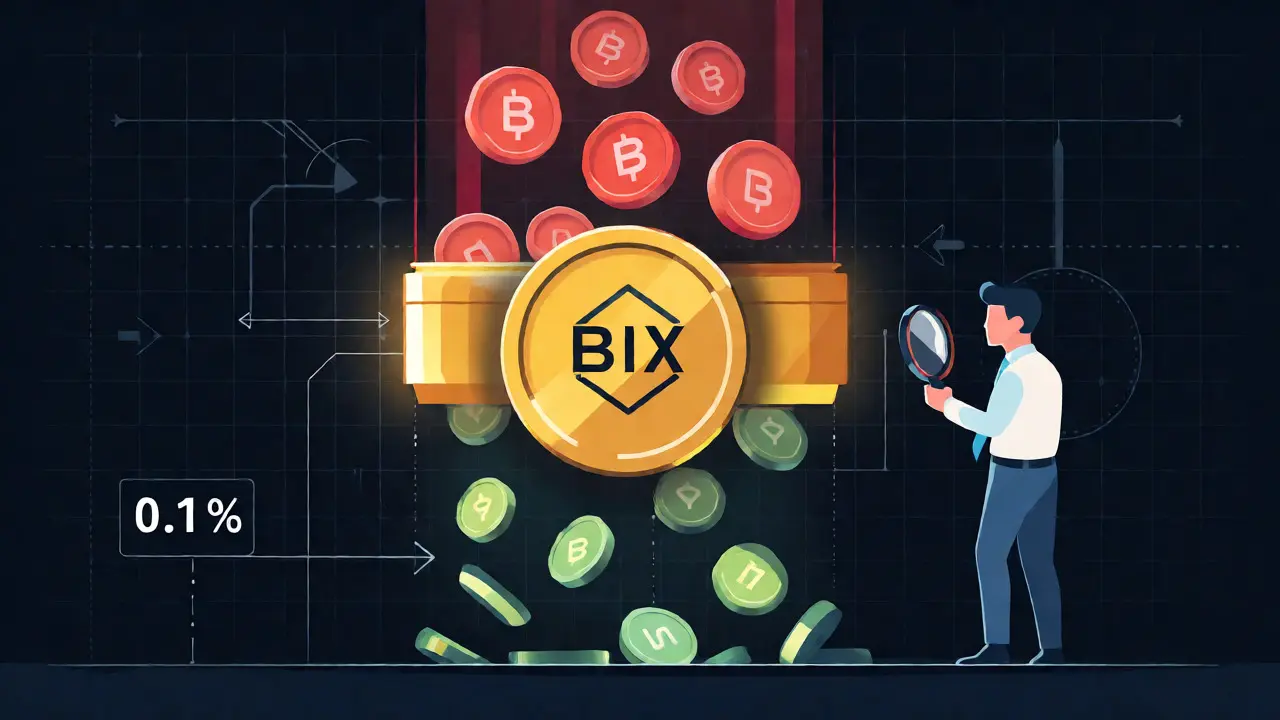
Let’s talk money. Nobody likes paying fees, and Bibox tries to solve this with its tiered fee structure. Standard spot trading fees start at 0.1%, which is competitive but not groundbreaking. However, if you hold and use BIX tokens to pay for fees, you can drop this rate significantly-down to 0.01% for top-tier holders.
This is where the strategy comes in. You aren’t just buying Bitcoin; you’re effectively buying a discount coupon. For high-volume traders, holding enough BIX to reach the lowest tier can save thousands of dollars annually. Futures trading fees are also attractive, starting at 0.04%. But remember: these low fees come with the caveat that you must actively manage your BIX holdings. If you forget to enable BIX payments, you’ll pay the higher standard rates without realizing it.
| Service | Standard Fee | Fee with BIX Discount | Industry Average |
|---|---|---|---|
| Spot Trading | 0.1% | 0.01% - 0.08% | 0.1% - 0.2% |
| Futures Trading | 0.04% | 0.03% - 0.04% | 0.02% - 0.05% |
| Withdrawals | Variable by coin | No specific discount | Variable by coin |
Trust Score and User Reputation
Here is the elephant in the room: trust. A quick glance at review sites tells a worrying story. On Trustpilot, Bibox holds a dismal 1.1 out of 5 stars based on hundreds of reviews. Users frequently cite withdrawal delays, unresponsive customer support, and frozen accounts during market volatility. ScamAdviser gives it a moderate 70/100, while Traders Union scores it a low 3.37/10, labeling it "higher-than-average risk."
Why the disconnect between the feature set and the reputation? Mostly operational failures. Many complaints stem from KYC (Know Your Customer) issues. Users report uploading documents and waiting weeks for approval, only to have withdrawals rejected for minor errors. For a casual trader wanting to buy $100 of ETH, this friction is annoying. For a pro trader needing liquidity during a crash, it’s disastrous.
If you choose Bibox, treat it like a hot wallet, not a bank vault. Keep large amounts of capital elsewhere. Use Bibox primarily for accessing unique assets, then move profits immediately to a hardware wallet or a more established exchange like Kraken or Coinbase.
Key Features: Beyond Basic Trading
Bibox doesn’t just do spot trading. It offers a suite of advanced tools that appeal to aggressive traders. Margin trading allows leverage up to 1:150, which is incredibly high. This means you can control a large position with very little capital. But beware: with great power comes great liquidation risk. One wrong move, and your entire position vanishes.
They also offer NFT trading and passive investment products like staking. The interface integrates with TradingView, so if you’re used to professional charting tools, you’ll feel at home. The mobile app mirrors the desktop functionality well, allowing you to monitor positions on the go. However, the "AI matching engine" claim is largely invisible to the end-user. You won’t see a dashboard showing how much AI saved you today. It’s mostly marketing speak unless you’re running algorithmic bots via their API.
Deposits, Withdrawals, and Fiat Limitations
A major hurdle for new users is the lack of direct fiat deposits. You cannot simply link your bank account and buy Bitcoin with USD or EUR directly on Bibox. Instead, you must deposit cryptocurrency from another wallet. This adds a step: buy crypto elsewhere, send it to Bibox, then trade. For US-based users, this is a significant inconvenience compared to platforms like Coinbase that allow instant card purchases.
Withdrawal speeds vary wildly. Some users report receiving funds in minutes; others wait days. During high-traffic periods, such as bull market peaks, delays seem to compound. Always test the withdrawal process with a small amount before committing significant capital. Also, note that minimum deposits are low ($1 equivalent), making it accessible for micro-investors, but the hassle of managing multiple transactions might outweigh the benefit for small balances.
Who Should Use Bibox?
Bibox isn’t for everyone. It’s a niche player in a crowded market. Here’s a quick decision matrix to help you decide:
- Use Bibox if: You are an experienced trader looking for obscure altcoins not listed on major exchanges; you understand how to manage BIX token tiers for fee discounts; you are comfortable with higher risk for potential higher rewards; you already hold crypto and don’t need fiat on-ramps.
- Avoid Bibox if: You are a beginner who needs hand-holding and reliable customer support; you require fast, guaranteed withdrawals for emergency cash access; you prefer regulatory clarity and insurance protections found in US-regulated exchanges; you want to buy crypto directly with a credit card.
Final Verdict
Bibox is a double-edged sword. On one side, you get access to a vast universe of cryptocurrencies and competitive fees for active traders. On the other, you face significant operational risks, poor customer service ratings, and a lack of robust regulatory oversight. It’s not a scam, but it’s not a safe haven either.
If you’re willing to do the legwork, manage your own security rigorously, and accept the possibility of occasional withdrawal hiccups, Bibox can serve as a useful secondary exchange for altcoin hunting. Just don’t make it your primary banking partner. Diversify your risk. Keep your core holdings on trusted, regulated platforms, and use Bibox only for the specific assets it uniquely offers.
Is Bibox safe to use in 2026?
Bibox carries a moderate-to-high risk profile. While it hasn't suffered a catastrophic hack recently, its low Trustpilot rating (1.1/5) and reports of withdrawal delays suggest operational weaknesses. It is generally considered safer than unknown offshore exchanges but less secure than heavily regulated giants like Coinbase or Kraken. Users should employ two-factor authentication and avoid keeping large sums on the platform long-term.
Does Bibox accept US customers?
Yes, Bibox accepts users from the United States, but it does not operate under a specific US federal license. This means US users may face stricter KYC requirements and limited fiat integration. Additionally, certain derivatives or tokens available globally might be restricted for US residents due to SEC regulations. Always check the latest terms of service for your specific region.
How do I reduce trading fees on Bibox?
You can reduce fees by holding and using the native BIX token. By enabling BIX payment for transaction fees, you unlock discounted rates. The more BIX you hold, the lower your tier, with the highest tier offering fees as low as 0.01% for spot trading. This requires maintaining a balance of BIX in your account, so factor in the price volatility of BIX itself when calculating savings.
Can I buy crypto with a credit card on Bibox?
Direct fiat purchases via credit card are limited or unavailable depending on your region. Bibox primarily functions as a crypto-to-crypto exchange. Most users purchase cryptocurrency on a fiat-on-ramp exchange (like Coinbase or MoonPay) and then transfer those coins to their Bibox wallet. Check the "Buy Crypto" section in the app for current third-party integrations available in your country.
What is the maximum leverage available on Bibox?
Bibox offers margin trading with leverage up to 1:150 for certain pairs. This is significantly higher than many mainstream exchanges, which often cap leverage at 10:1 or 20:1 for retail users. High leverage increases both potential profit and the risk of rapid liquidation, so it is recommended only for experienced traders with strict stop-loss strategies.