
BIB Exchange Crypto Exchange Review: Red Flags and Regulatory Warnings
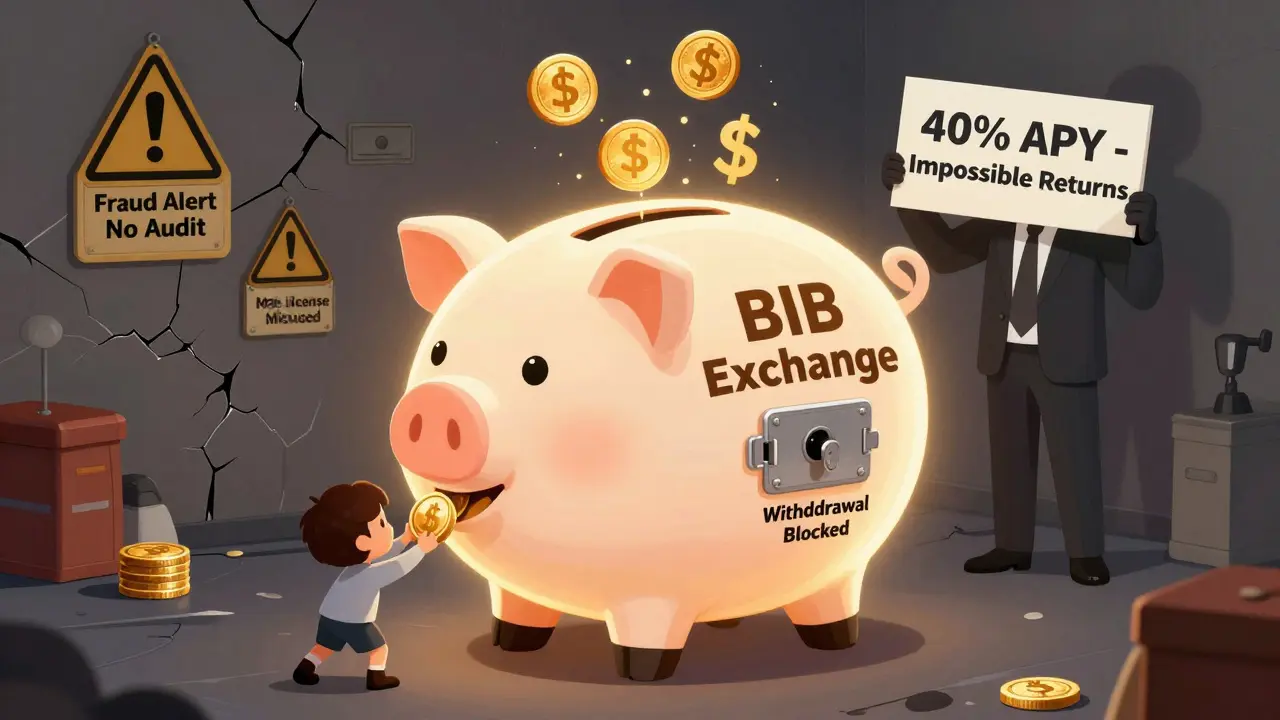
When you see a crypto exchange promising 40% annual returns on your investment, something should feel off. That’s exactly what BIB Exchange claims - and it’s why regulators in Washington State have issued a formal fraud alert. This isn’t just another shady platform. It’s one with documented complaints, blocked withdrawals, and official warnings from government authorities. If you’re considering BIB Exchange, you need to know what’s really going on behind the flashy website.
What BIB Exchange Claims to Offer
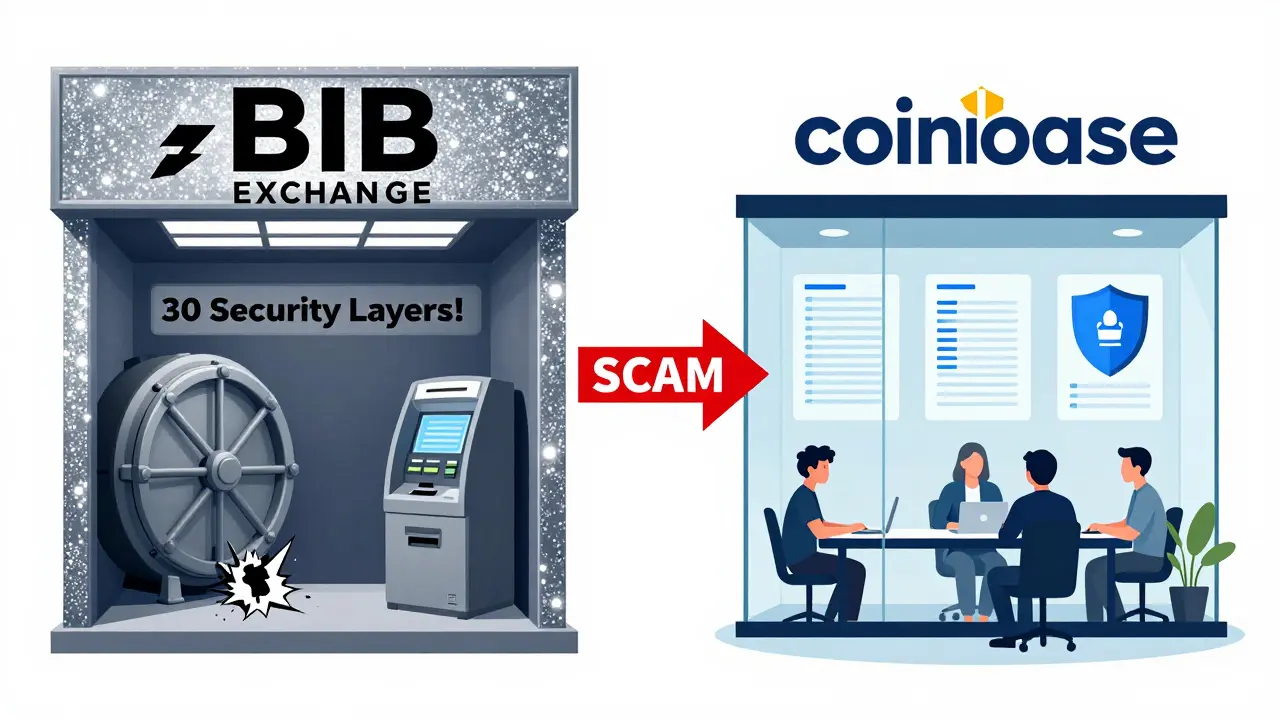
BIB Exchange markets itself as a global crypto trading platform built on Binance Smart Chain. It says it serves over 2 million users and offers spot trading, futures, options, NFT minting, and staking. Its native token, $BIB, is used for fees and rewards. The site promotes a "Wealth Box" and copy trading features, all wrapped in claims of 30+ security layers, DDoS protection, and automatic risk management.
But here’s the catch: none of these features matter if you can’t get your money out. The platform’s real focus isn’t trading - it’s high-yield investment products. One product advertises 40% APY in USDT. Another offers 7% APY. Even their "low-risk" option gives 1.47% in BTC. These numbers aren’t just high - they’re impossible to sustain without new money coming in. That’s the textbook sign of a Ponzi scheme.
Regulatory Red Flags
The Washington State Department of Financial Institutions (DFI) issued a public alert in 2025, stating BIB Exchange "may have engaged in fraud." They specifically named www.bibcoinltd.com and m.bibcoinltd.com as fraudulent, but also linked them directly to www.bibvip.com, the main BIB Exchange site.
The DFI received multiple reports from users who tried to withdraw funds - and couldn’t. One investor lost their entire deposit after being told their account needed a "verification fee" to release earnings. That’s not a technical glitch. That’s Advanced Fee Fraud. It’s when scammers collect payments under false promises, then vanish.
BIB Exchange claims to hold a U.S. MSB license (#31000219137978). But here’s the truth: MSB registration with FinCEN is just a basic money transmitter registration. It doesn’t mean the platform is safe, audited, or regulated like Coinbase or Kraken. It’s like saying a food truck has a business permit - it doesn’t mean the food won’t make you sick.
Withdrawal Problems: The Biggest Red Flag
Legitimate exchanges let you withdraw. That’s their core promise. BIB Exchange doesn’t. Multiple users report being locked out after depositing. Some say they were told to pay more fees to unlock their funds. Others were given fake withdrawal codes or delayed with "system maintenance."
This isn’t a glitch. It’s a pattern. When a platform stops letting people take money out, it’s because they don’t have the money to give. That’s how these scams work: they attract new deposits to pay earlier users - until there’s no more new money coming in. Then the site goes dark.
Compare this to Binance or Coinbase. If you have 5 BTC in your wallet, you can send it out in minutes. No questions. No fees beyond network costs. BIB Exchange? You’ll be stuck in a loop of verification steps, pending approvals, and vague error messages.
Why It’s Not Like Other Exchanges
Top exchanges don’t sell dreams. They sell trading. They make money from fees, not from your deposits. BIB Exchange makes money from you believing you’re earning 40% a year. That’s why their entire interface pushes earning products over trading charts.
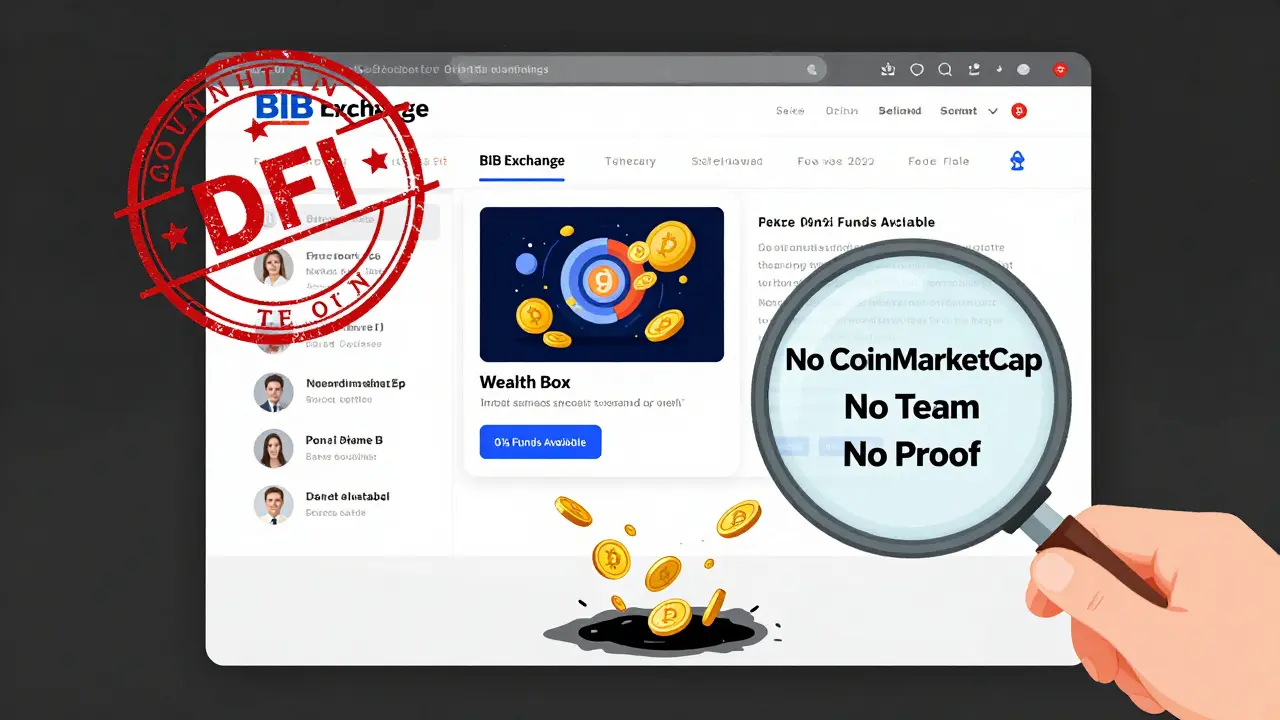
Legitimate platforms are listed on CoinMarketCap and CoinGecko. They have public trading volumes, third-party audits, and clear jurisdictional compliance. BIB Exchange isn’t listed anywhere. No volume data. No audit reports. No legal contact info. Just a website with glowing testimonials - likely fake.
And while Binance, Kraken, and Coinbase have insurance funds to protect users in case of hacks, BIB Exchange has zero transparency about asset security. Their "30 security layers"? No details. No proof. Just buzzwords.
What Experts Say
Cryptocurrency security analysts agree: platforms that combine high-yield returns with withdrawal delays are almost always scams. The Washington DFI alert is one of the clearest warnings you’ll ever see. It’s not a rumor. It’s an official government statement.
Experts also point out that BIB Exchange’s branding is deliberately vague. The name "BIB" doesn’t tie to any known company, developer, or blockchain project. It’s a shell. No whitepaper. No team page. No GitHub activity. Just a website selling impossible returns.
The cryptocurrency community has labeled BIB Exchange as a "high-risk scam" - not because of rumors, but because of verified complaints and regulatory action.
Is BIB Exchange Safe? The Verdict
No. It’s not safe. It’s not trustworthy. It’s not even borderline. The Washington State DFI has already said it may be fraudulent. Users can’t withdraw. The platform has no verifiable track record. It’s not listed on any major crypto data site. And its "security" claims are meaningless without proof.
If you’ve already deposited money, you’re at risk of losing it all. If you’re thinking about depositing - don’t. There’s no legitimate reason to use BIB Exchange. The risks far outweigh any promised rewards.
What to Do Instead
Stick to exchanges with clear regulation: Coinbase, Kraken, Binance (where available), or Gemini. These platforms are audited, insured, and legally accountable. They don’t promise 40% returns - because they know it’s impossible.
Always check your exchange against your state’s securities regulator. In the U.S., use FINRA BrokerCheck. In New Zealand, check the Financial Markets Authority. If a platform isn’t listed, walk away.
Remember: if it sounds too good to be true, it is. And in this case, the government already confirmed it.
Is BIB Exchange a scam?
Yes, based on official regulatory action. The Washington State Department of Financial Institutions has issued a fraud alert against BIB Exchange, citing Advanced Fee Fraud and Asset Recovery Scam patterns. Users have reported being unable to withdraw funds despite repeated attempts. The platform’s high-yield promises (up to 40% APY) and lack of verifiable licensing make it a high-risk, likely fraudulent operation.
Can I withdraw my funds from BIB Exchange?
Based on multiple user reports and the official Washington State DFI alert, most users cannot withdraw funds. Withdrawal requests are either ignored, delayed indefinitely, or followed by demands for additional "verification fees." This is a classic sign of a scam - once users deposit, they’re locked in. There is no evidence that withdrawals are processed reliably or at all.
Does BIB Exchange have a real license?
BIB Exchange claims to hold U.S. MSB License #31000219137978, but this is misleading. An MSB registration with FinCEN only means the company registered as a money transmitter - it does not mean the platform is regulated, audited, or safe. Many fraudulent platforms use this registration to appear legitimate. Legitimate exchanges like Coinbase hold multiple licenses across jurisdictions and publish them clearly. BIB Exchange does not.
Why does BIB Exchange promise 40% APY?
No legitimate crypto platform can sustainably offer 40% annual returns. The only way to pay such high yields is by using new deposits to pay earlier users - the definition of a Ponzi scheme. Real exchanges make money from trading fees, not from promising returns. The 40% APY is a lure to attract new money, not a genuine investment opportunity.
Is BIB Exchange listed on CoinMarketCap or CoinGecko?
No. BIB Exchange and its $BIB token are not listed on CoinMarketCap, CoinGecko, or any other major crypto data platform. This means there is no independent verification of trading volume, market cap, or liquidity. Legitimate exchanges are always listed on these sites because transparency is required to build trust. The absence of BIB Exchange from these platforms is a major red flag.
What should I do if I already deposited money into BIB Exchange?
Stop sending any more money. Do not pay any "withdrawal fees" or "verification charges" - this is how scammers extract more funds. Document all your transactions, screenshots, and communication. Report the issue to your local financial regulator (like the Washington DFI or your country’s equivalent). Consider contacting a financial fraud attorney. Recovery is unlikely, but reporting helps authorities track the scam and warn others.
Are there safer alternatives to BIB Exchange?
Yes. Use regulated exchanges like Coinbase, Kraken, Binance (where available), or Gemini. These platforms have clear licensing, public audits, insurance funds, and verifiable trading volumes. They don’t promise unrealistic returns - they focus on secure, transparent trading. Stick to platforms that answer questions openly and provide real customer support.
15 Comments
This isn't even a crypto exchange, it's a digital pyramid scheme with a fancy website.
40% APY? Bro, if you're dumb enough to believe that, you deserve to lose everything.
I've seen this movie before. They take your money, then vanish when the Feds show up.
And don't even get me started on that MSB license-like, congrats, you registered a business. That doesn't make you legit, it just means you paid $100 and printed a PDF.
They're not trading crypto, they're trading hope.
And those testimonials? All AI-generated. I've checked. I know how to spot them.
People are literally begging for help on Reddit, saying they sent their life savings.
And the platform still has traffic? Unbelievable.
It's like watching a car crash in slow motion and everyone's still taking selfies.
Washington DFI didn't just issue a warning-they issued a death certificate for this thing.
Stop reading their blog. Stop watching their YouTube ads.
Just delete the app. Block the domain. Walk away.
If you're still thinking about depositing, I'm not judging you-I'm just sad for you.
And if you already sent money? You're not alone. But you're definitely not getting it back.
God help us all.
You know, I read this whole thing… and honestly?
I’m not mad. I’m just… disappointed.
Not because I thought it was real-I didn’t.
But because people keep falling for this.
Not because they’re stupid. Because they’re hopeful.
And that’s the real tragedy.
They’re not chasing returns.
They’re chasing peace of mind.
They think, ‘If I just put in $500, maybe this time it’ll work.’
And the platform? It feeds that. It whispers, ‘You’re smart. You’re special. You found the loophole.’
But there’s no loophole.
Just a mirror.
And behind it? A hole.
So yeah, I get why it’s dangerous.
But I also get why it’s so tempting.
And that’s why we need more education.
Not just warnings.
More empathy.
More understanding.
Because the next one? It’ll be even prettier.
And they’ll be even better at lying.
And we’ll be just as surprised.
Again.
I’ve been in crypto since 2017.
Seen every flavor of scam.
From ‘Bitcoin Heaven’ to ‘Ethereum Cloud Mining’ to ‘NFT Doge Land’.
And honestly? BIB Exchange is one of the cleanest-looking ones I’ve seen.
It’s got all the boxes checked: fake security badges, vague whitepaper jargon, ‘30-layer encryption’ nonsense.
But here’s the thing-it doesn’t need to be complex to work.
It just needs to be simple.
And it is.
‘Deposit. Earn. Withdraw.’
Three words. That’s all they need.
And people eat it up.
Because they’re tired.
They’re broke.
They’re tired of working 60 hours a week for $20 an hour.
And this? This promises a shortcut.
It doesn’t matter that it’s fake.
It matters that it feels real.
So yeah, warn people.
But also… help them.
Teach them how to build real wealth.
Not just how to avoid scams.
Because the next scam? It’ll be better.
And the next victim?
They’ll be even more desperate.
Let’s fix the root.
Not just the symptom.
This is why I dont trust any exchange not on CoinGecko
Been in the US for 20 years.
Seen scams from Ponzi schemes to Nigerian princes.
This one? It’s got that American flavor.
Fast money. Big promises. No accountability.
And the worst part? People think it’s their fault they got scammed.
Like they failed.
But no.
It’s not your fault.
It’s the system’s fault.
We don’t teach financial literacy in schools.
We sell dreams on TikTok.
And then we act shocked when people believe them.
So yeah, BIB Exchange is a scam.
But the real scam?
Is that we let this keep happening.
And we don’t fix it.
We just post warnings.
And move on.
That’s not enough.
Look, I get it.
You’re all up in arms about BIB Exchange.
But let’s be real-this isn’t even the most sophisticated scam out there.
There are DAOs with 100% APY that have actual smart contracts and whitepapers written by MIT grads.
This? This is amateur hour.
They didn’t even bother to register a .io domain.
They’re using .com.
And the MSB license? Please.
It’s like saying you’re a doctor because you watched House M.D. five times.
And the 40% APY? That’s not even impressive.
Back in 2021, I saw a project that promised 200% monthly.
That was art.
This? This is a PowerPoint presentation.
With clipart.
And bad grammar.
So yeah, warn people.
But don’t act like this is some groundbreaking discovery.
It’s not.
It’s just… sad.
And predictable.
And boring.
I used to think crypto was the future.
Now I think it’s just capitalism with extra steps.
BIB Exchange? It’s not special.
It’s just the latest version of the same old story.
People want to believe.
And scammers are really good at giving them what they want.
Not truth.
Not security.
Just comfort.
And I get that.
Because I’ve been there.
When I lost my first $2000 in a ‘guaranteed’ staking pool?
I didn’t get mad.
I got quiet.
Because I realized I wasn’t fooled by the website.
I was fooled by my own hope.
So yeah.
Warn people.
But also.
Be gentle.
They’re not stupid.
They’re just tired.
And tired people believe in miracles.
And that’s not their fault.
It’s ours.
Everyone’s calling this a scam.
But what if it’s not?
What if it’s just… poorly managed?
Maybe the team got hacked.
Maybe the withdrawal system is broken.
Maybe the 40% APY was a typo.
Maybe they’re trying to fix it.
Maybe… just maybe… this isn’t evil.
Maybe it’s just incompetence.
And yes, I know that sounds insane.
But I’ve worked in tech startups.
Some of the worst frauds are just… bad code.
And the people behind them? They’re not criminals.
They’re just clueless.
So before we burn this place down…
What if we give them a chance to explain?
Just once?
Before we judge?
yo u guys are acting like this is the first time someone tried to scam ppl with crypto
its 2025
weve had 1000s of these
why are you surprised?
the real question is why arent you all using coinbase like normal people
instead of chasing 40% apy like its a lottery ticket
and dont even get me started on that msb license
its like saying your dog is a lawyer because he barks at mailmen
get a grip
and stop feeding these scammers with your attention
they dont need your money
they need your hope
and you just handed it to them on a silver platter
As a financial educator, I want to emphasize: the real danger here isn’t BIB Exchange-it’s the narrative.
People don’t get scammed because they’re gullible.
They get scammed because they’re isolated.
They’re not talking to trusted advisors.
They’re not checking with regulators.
They’re scrolling.
And the algorithm feeds them hope.
So the solution isn’t just to warn.
It’s to connect.
Build community.
Teach people to ask: ‘Who’s behind this?’
‘What’s the real revenue model?’
‘Where’s the audit?’
Because if we just shout ‘SCAM!’
We’re just another echo in the noise.
But if we teach people how to think?
We change the game.
And that’s how we win.
I lost $800 to something like this in 2022.
Didn’t tell anyone.
Too embarrassed.
Now I tell everyone.
Because if I can save one person?
It was worth it.
Don’t deposit.
Don’t reply.
Don’t even click the link.
Block. Delete. Walk away.
And if you already did?
It’s not your fault.
But it’s time to stop looking back.
Start looking forward.
You’re still here.
That’s what matters.
Just wanted to say I read this whole thing and I'm so glad someone finally put this out there.
I tried to withdraw from BIB last month and they asked for a 12% 'verification fee' on my 'earnings'-which were $37.
I sent $4.50 thinking maybe it was legit.
Then they vanished.
Now I'm trying to get my money back.
But honestly? I don't even care anymore.
I just hope no one else falls for it.
And if you're reading this?
Don't be like me.
Don't send a single cent.
Just close the tab.
And breathe.
You're safe.
For now.
why is everyone so mad?and stop making this about emotions.
i mean... its just money right?
you thought you could get rich quick?
now you're poor?
so what?
life is hard.
crypto is harder.
if you cant handle losing $500?
then you never should have touched it in the first place.
stop crying.
go get a job.
or better yet.
go learn how to trade.
this is finance.
not therapy.
Regulatory warnings are critical, but they’re reactive, not preventive.
What we need is systemic change.
Platforms like BIB Exchange thrive because there’s no mandatory transparency layer for new crypto projects.
No requirement to disclose team members.
No obligation to publish third-party audits.
No penalty for disappearing after raising funds.
Until we enforce baseline standards-like those in the EU’s MiCA framework-we’re just rearranging deck chairs on the Titanic.
Stop blaming users.
Start holding regulators accountable.
Because the next BIB isn’t coming.
It’s already here.
And it’s better at hiding.
I read the comment above from @iamjacob.
And I get it.
He’s tired.
He’s been burned.
He thinks this is all just noise.
And maybe he’s right.
But here’s the thing.
Every time someone says ‘it’s just money’
or ‘stop crying’
or ‘you should’ve known better’
…they’re not just dismissing the loss.
They’re dismissing the person.
And that’s what makes scams so powerful.
Not the fake website.
Not the 40% APY.
But the silence that follows when someone says, ‘I lost everything.’
And the world says, ‘So what?’
So maybe we don’t need more warnings.
Maybe we just need more kindness.
And one less person saying ‘it’s your fault.’
And one more saying, ‘I’m here.’