
Algorithmic Stablecoins: How They Work

Most people think stablecoins are just digital dollars backed by real cash. But what if a coin could stay worth exactly $1 without holding a single dollar in reserve? That’s the promise of algorithmic stablecoins. They don’t rely on banks or vaults. Instead, they use code - smart contracts and algorithms - to automatically adjust how many coins are in circulation. When the price goes up, more coins are created. When it drops, coins vanish. It’s like a self-correcting economy, running on blockchain.
How Do Algorithmic Stablecoins Stay at $1?
Imagine you own a coin that’s supposed to be worth $1. One day, everyone wants it, and the price jumps to $1.20. The algorithm notices this. It responds by printing new coins and flooding the market. More supply means the price drops back to $1. Now imagine the price crashes to $0.80. The system doesn’t panic. It burns coins - removes them from circulation - so scarcity pushes the price back up. No human decides this. No central bank approves it. The code does it all.
This isn’t magic. It’s math. And there are two main ways it works: seigniorage shares and rebasing.
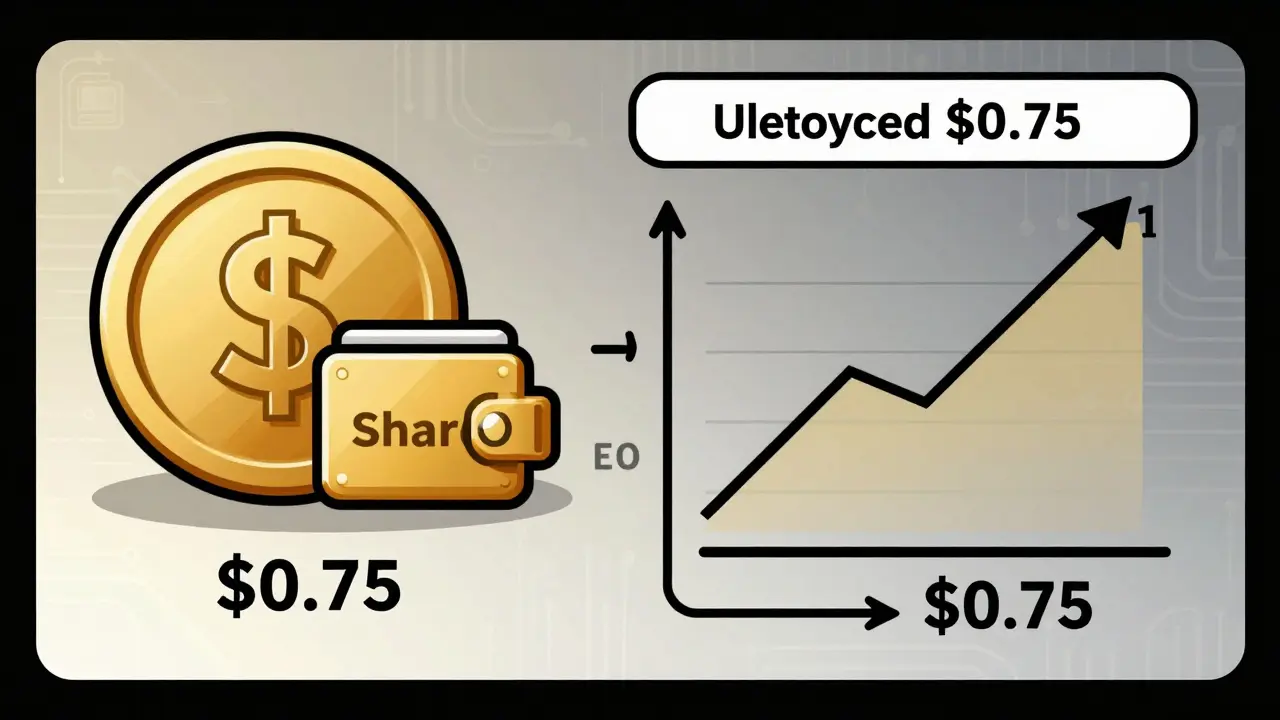
Seigniorage systems use two tokens. One is the stablecoin (say, $1 pegged). The other is a bond token, often called a "share" or "reserve" token. When the stablecoin drops below $1, you can buy those bond tokens at a discount. Say the stablecoin is at $0.75. You spend $0.75 to buy a bond token. Later, when the price returns to $1, you can redeem that bond for $1. You make $0.25 profit. Meanwhile, the protocol takes the $0.75 you paid and uses it to buy back and burn stablecoins - reducing supply and helping the price recover.
Rebasing works differently. Instead of two tokens, it changes your balance automatically. If the price rises to $2, the protocol doubles your holdings. You had 10 coins worth $10 total. Now you have 20 coins - still worth $20. Each coin is now $1 again. If the price falls to $0.50, your balance gets cut in half. You had 10 coins. Now you have 5. But your total value stays the same. Your wallet doesn’t change, but the number of coins does. It’s like inflation and deflation built into your balance.
Real Examples: What’s Out There?
Not all algorithmic stablecoins are the same. Some tried one model. Others mixed ideas.
Ampleforth (AMPL) is one of the earliest and purest rebasing stablecoins. It doesn’t try to stay at $1 forever. It just adjusts supply daily to match demand. If AMPL trades at $1.50, your wallet gets more AMPL. If it’s at $0.70, you get fewer. Your percentage of the total supply stays the same. It’s a supply experiment - not a dollar peg.
Frax (FRAX) is different. It’s a hybrid. About 80% of FRAX is backed by USDC or other assets. The rest? Algorithmic. If FRAX drops below $1, the algorithm mints new FRAX and sells it for collateral to buy back the undervalued coins. If it rises above $1, it issues new FRAX and sells FXS (its governance token) to absorb the extra supply. It’s not fully decentralized - but it’s more stable than pure algorithmic models.
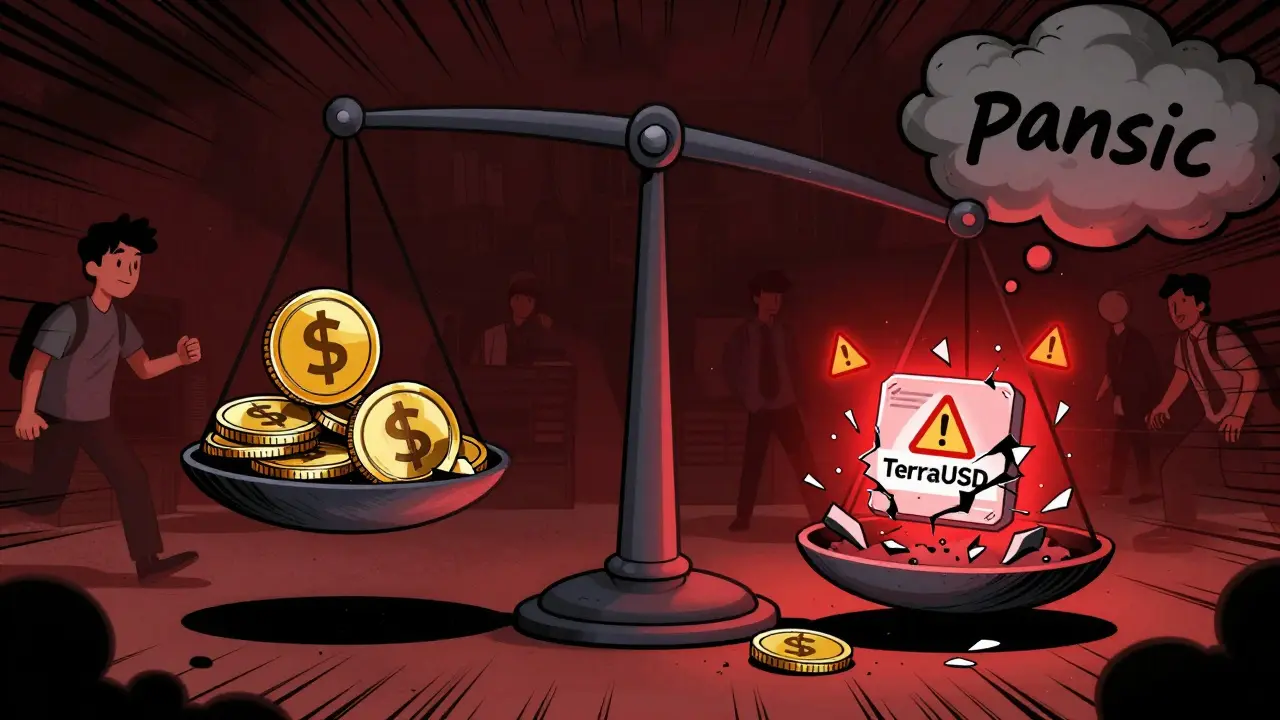
Then there’s the ghost of TerraUSD (UST). Before May 2022, UST was the biggest algorithmic stablecoin. It used a dual-token system with LUNA. When UST dropped below $1, users could burn $1 worth of LUNA to mint 1 UST. When UST rose above $1, they could burn 1 UST to mint $1 worth of LUNA. The idea was simple: arbitrage would keep the peg. But when panic hit, no one wanted LUNA. The feedback loop broke. UST crashed to 30 cents. LUNA went from $80 to $0.0001. Billions vanished. It wasn’t a glitch. It was a design flaw - and it shook the whole crypto world.
Why Do People Even Use Them?
Because they’re decentralized. No bank holds the money. No government can freeze your coins. If you hold USDC, Circle Inc. can pause withdrawals. With algorithmic stablecoins, there’s no middleman. The contract runs on its own. That’s powerful.
They’re also capital-efficient. Backing every stablecoin with real dollars means billions sit idle in bank accounts. Algorithmic models use crypto collateral or market incentives instead. That frees up capital for other DeFi uses - lending, yield farming, liquidity pools.
And they’re transparent. Every mint, burn, and rebasing is on-chain. Anyone can audit it. No hidden reserves. No shady accounting.
The Big Risks: Why Most Fail
But here’s the truth: algorithmic stablecoins are fragile. They work beautifully in calm markets. They collapse in panic.
First, they rely on market confidence. If people start doubting the peg, they sell. That triggers more burning, which lowers prices further. It’s a death spiral. UST didn’t fail because of a bug. It failed because users lost faith.
Second, they need deep liquidity. If you can’t easily swap your stablecoin for ETH or USDC when the price drops, the algorithm can’t fix it. Many projects don’t have enough trading volume to absorb shocks.
Third, they’re vulnerable to flash crashes. A single large sell order can break the peg. Once it drops below $0.95, the incentive to buy bonds or rebalance weakens. The system stalls. And once it stalls, recovery is hard.
And then there’s regulation. Governments don’t know how to classify these. Are they securities? Commodities? Unbacked currencies? Until regulators give clarity, adoption will stay limited.
What’s Next? Hybrid Models Are Winning
The pure algorithmic model is fading. The smart money is moving to hybrids.
Frax proved it’s possible to combine partial backing with algorithmic adjustments. Now projects like FEI and DAI (yes, DAI uses partial collateral and algorithmic incentives too) are doing the same. They don’t go all-in on code. They use real assets as a safety net - but still let algorithms fine-tune supply.
Future designs will likely include:
- Dynamic collateral ratios - more backing when volatility spikes
- Decentralized oracle systems - real-time price feeds from multiple sources
- Community-managed risk buffers - users vote to freeze minting during crises
- Clearer risk disclosures - no more "this is 100% decentralized" claims without caveats
The goal isn’t to eliminate backing. It’s to make backing smarter. To use code not as a replacement for trust, but as a tool to enhance it.
Should You Use Them?
If you’re new to crypto, avoid them. Stick with USDC or USDT. They’re simple. They’re backed. They’re regulated.
If you’re experienced and understand the mechanics - and you’re okay with losing money if the peg breaks - then experiment. But never put in more than you can afford to lose. Use a hardware wallet. Never store them on an exchange. And always check the protocol’s latest audits and governance votes.
Algorithmic stablecoins are an elegant idea. But elegance doesn’t pay bills. Stability does. And right now, code alone can’t guarantee that.
Are algorithmic stablecoins really decentralized?
They’re more decentralized than fiat-backed ones because they don’t rely on a company holding reserves. But many still depend on governance tokens controlled by a small group of early investors or developers. If those people vote to change the rules, the system can shift. True decentralization means no one can change the code - and very few algorithmic stablecoins achieve that.
Can algorithmic stablecoins be used for everyday payments?
Technically, yes - but practically, no. Most merchants won’t accept them because their value can swing unpredictably. Even if the peg is stable for weeks, a single market crash can wipe out confidence overnight. For daily use, USDC or even Bitcoin (in some regions) are more reliable.
Why did Ampleforth (AMPL) stop trying to be a $1 stablecoin?
Because it didn’t work. AMPL was designed to rebaseline daily to maintain $1, but users kept selling when supply increased and buying when it dropped. This created wild price swings. Instead of stability, it became a speculative asset. The team eventually admitted the model couldn’t maintain a stable peg and shifted focus to being a volatility index token - not a dollar substitute.
Is there any algorithmic stablecoin that’s still working today?
No pure algorithmic stablecoin has survived long-term without some form of collateral. Frax comes closest - it’s 80% backed by USDC and uses algorithms to adjust the rest. But even Frax had to increase its collateral ratio after UST crashed. The market now prefers partial backing. Pure algorithmic models are seen as too risky.
How do I know if an algorithmic stablecoin is safe?
Check three things: 1) How much collateral backs it? (More than 50% is safer.) 2) Is the code audited by at least two reputable firms? 3) Is there a clear emergency stop? (Like freezing minting if price drops below $0.90?) If any answer is "no," avoid it. Also, watch the community. If developers are silent or the forum is full of panic, walk away.
15 Comments
Algorithmic stablecoins are the ultimate DeFi experiment-no central authority, just math doing the heavy lifting. I love how Frax blends collateral with algorithmic tweaks; it’s like having a safety net made of code. The rebasing mechanism is genius-your balance adjusts automatically, no manual trading needed. It’s not perfect, but it’s the closest we’ve gotten to a truly autonomous monetary system. The UST collapse was brutal, but it taught us that pure algorithmic models need breathing room. Hybrid is the future.
And honestly? We’re not just building a currency-we’re building a new financial OS. The fact that you can audit every mint and burn on-chain? That’s transparency on steroids.
Yo this is wild 😎 I mean… code just printing and burning money like it’s a video game economy? I’m here for it. AMPL tried to be the rebel without a cause-no peg, just vibes-and honestly? It became a meme coin with a PhD. But Frax? Now that’s the real MVP. 80% backed? Smart. Let the algo do the fine-tuning while the USDC holds down the fort. No need to be 100% pure if 80% works better. 💪
People keep saying algorithmic stablecoins are decentralized but they’re not-they’re just controlled by a small group of devs who can change the rules with a vote. UST didn’t fail because of math. It failed because trust evaporated. And trust isn’t coded. It’s human.
Let’s be real-this whole ‘algorithmic stablecoin’ thing is just crypto bros trying to replace the dollar without understanding how money actually works. The US dollar isn’t backed by gold anymore. It’s backed by the US military, global trade dominance, and the fact that no one else has a better option. You think a smart contract can outlast that? Wake up. This isn’t innovation. It’s delusion wrapped in a whitepaper.
They’re all going to crash. Mark my words. The UST collapse was just the first domino. These systems are built on trust and math. But trust breaks. Math gets hacked. And when the panic hits, there’s no lender of last resort. No Fed. No safety net. Just a bunch of devs watching their wallets burn. If you’re holding one, you’re gambling. And the house always wins.
There’s something poetic about the idea-code as a central bank. No bureaucracy. No political interference. Just an immutable rule set responding to market signals. But… I get nervous when I think about flash crashes. One big sell order, a liquidity crunch, and suddenly the whole mechanism stalls. It’s like a car with no brakes, relying only on the engine to slow down. It works… until it doesn’t. I respect the ambition. I just hope the safety margins are bigger than we think.
Look, I’ve been in crypto since 2017. I’ve seen bubbles, crashes, and cults form around tokens. But algorithmic stablecoins? They’re the most fascinating because they’re not trying to mimic the old system-they’re trying to replace it entirely. And yeah, most fail. But the ones that survive? They’ll change finance forever. Frax, FEI, even DAI with its hybrid model-they’re not perfect, but they’re evolving. We’re not just watching a tech trend. We’re witnessing the birth of a new monetary paradigm. Stay curious. Stay cautious. But don’t look away.
Very interesting breakdown. In India, we have seen how inflation erodes trust in fiat. Algorithmic models offer an alternative, but adoption is limited by infrastructure. Still, the concept of self-adjusting supply is brilliant. If we can solve oracle reliability and liquidity depth, this could be huge for emerging markets. No need for banks-just code and connectivity.
UST died because LUNA had no real value. If the anchor token is worthless, the whole system collapses. That’s why hybrids win. Backing matters. Code can’t fix a broken foundation.
Hybrids are the only way forward. Pure algorithmic? Too fragile. Partial backing? Smart. It’s not about eliminating trust-it’s about distributing it. Code doesn’t replace humans. It empowers them. And that’s the future.
Look, I’ve read the whitepapers, studied the econometrics, and I’m sorry-but algorithmic stablecoins are just a cleverly disguised ponzi with a blockchain UI. The entire premise assumes rational actors, perfect information, and infinite liquidity-all of which are fantasy in real markets. You think the market doesn’t game the rebasing? Of course it does. AMPL became a volatility play. Frax is just a wrapped USDC with extra steps. And DAI? It’s a debt engine masquerading as decentralization. This isn’t innovation. It’s financial theater.
I really appreciate how this breaks down the mechanics without jargon. It’s easy to get lost in the math, but the real story is about trust. The UST collapse wasn’t just technical-it was psychological. People stopped believing. And once that happens, no algorithm can bring it back. I think the future is in transparency-clear collateral ratios, open governance, and honest communication. Not hype.
Everyone’s talking about hybrids like they’re the answer. But what if the collateral gets frozen? What if USDC gets depegged? Then you’re back to square one. Algorithmic systems might be fragile, but at least they don’t rely on a single point of failure like Circle Inc. Maybe we need both-algorithmic for decentralization, collateral for stability. Not one or the other.
As someone who’s been in DeFi since the early days, I’ve watched so many ‘revolutionary’ projects fail. But algorithmic stablecoins? They’re different. Not because they’re perfect-but because they force us to ask harder questions. What is money? Who controls it? Can trust be automated? Even if they all crash, the conversation they sparked? That’s the real legacy.
The entire premise of algorithmic stablecoins rests upon a metaphysical fallacy: that economic equilibrium can be achieved through deterministic code. This is not merely an engineering challenge-it is an epistemological error. Human beings, by nature, are irrational actors embedded in nonlinear systems. To presume that a feedback loop, however elegantly constructed, can replicate the emergent properties of a monetary system governed by centuries of institutional inertia, is to commit the fallacy of scientism. The collapse of UST was not a bug-it was a necessary correction. The market, in its infinite wisdom, rejected the hubris of algorithmic governance. One must ask: if the system cannot be understood by its users, can it be trusted? And if it cannot be trusted, can it be valuable? The answer, in both philosophy and practice, is no.