
Active Addresses and Network Activity: What They Really Tell You About Blockchain Health

When you hear that Ethereum hit 650,000 active addresses in a single day, what does that actually mean? Is it a sign of real growth, or just a spike from bots and airdrop hunters? Too many people treat this number like a magic indicator - a simple count that proves a blockchain is booming. But the truth is more complicated. Active addresses aren’t a measure of users. They’re a measure of behavior. And if you don’t understand the difference, you’re reading the signals wrong.
What Exactly Is an Active Address?
An active address is any wallet that sent or received a transaction within a given time frame - usually daily, weekly, or monthly. It doesn’t matter if it sent 0.0001 ETH or 500 BTC. It doesn’t matter if the transaction failed, or if it was just a self-transfer. If the blockchain recorded it, the address gets counted. And it’s counted only once per period, no matter how many times it moved funds. For example, on February 24, 2023, Ethereum had 531,396 active addresses. That means 531,396 unique wallets were involved in at least one transaction that day. Some sent, some received, some did both. But each one was tallied once. This is different from total transactions. One user could send 15 transactions in a day - that’s 15 transactions, but only 1 active address. This metric became standard around 2014, as early blockchain explorers like Blockchain.com started tracking on-chain behavior. Today, firms like Coin Metrics, Santiment, and Nansen use it as a baseline for measuring network engagement. It’s not perfect, but it’s transparent. Unlike ad clicks or app downloads, you can’t fake on-chain activity. Every transaction is public, permanent, and verifiable.Why Active Addresses Matter More Than You Think
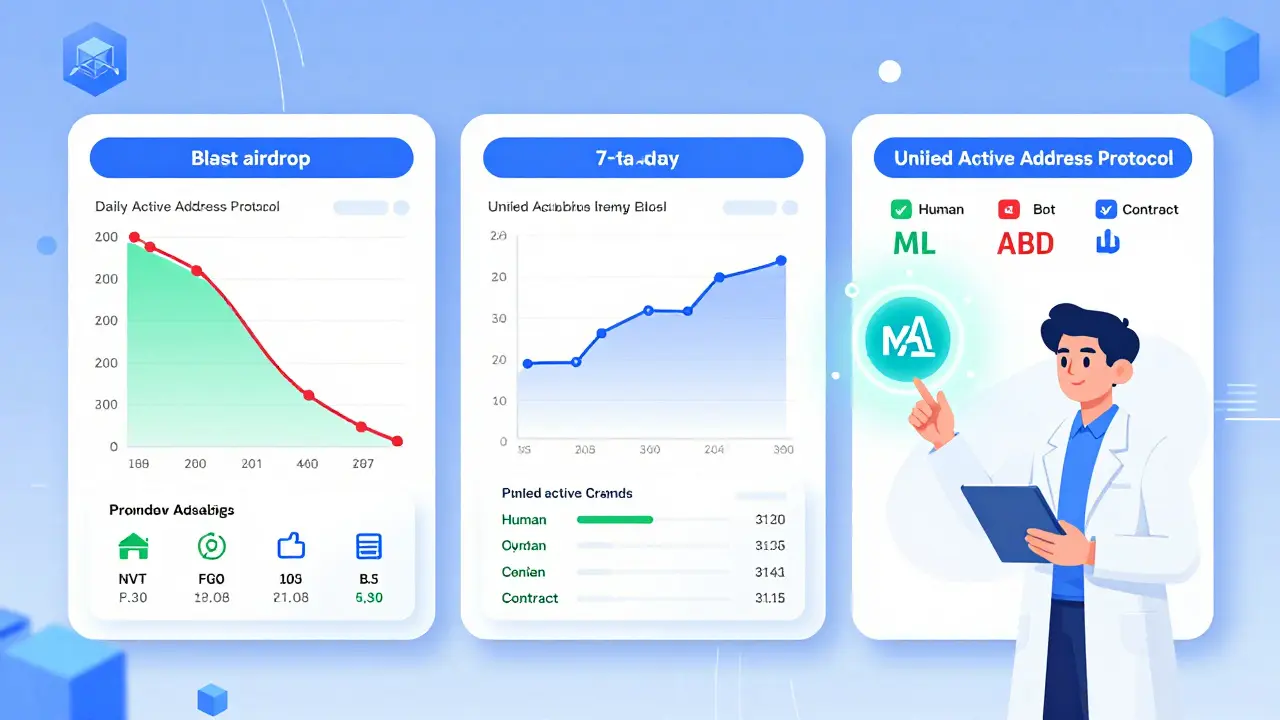
Most people look at price. But price can be manipulated. Volume can be pumped. Active addresses? Not so much. If a blockchain’s daily active addresses are climbing steadily over weeks or months, it means real people are using it - not just speculators flipping tokens. Delphi Digital found that blockchains with quarterly DAA growth above 20% were 3.2 times more likely to survive long-term. That’s not a coincidence. It’s a pattern. When users keep showing up, the network builds momentum. Developers build on it. Exchanges list it. Liquidity follows. Take Solana. In May 2023, it hit 3.2 million daily active addresses. That wasn’t just a flash in the pan. It was a surge driven by real users fleeing Ethereum’s high fees and slow speeds. The network handled the load. DeFi apps kept running. NFTs kept minting. The numbers reflected actual adoption. On the flip side, when active addresses drop - like after a major protocol collapse or a failed airdrop - it’s a red flag. A 400% spike in DAA for the Blast protocol in June 2023? That was all airdrop farming. Users created dozens of wallets to claim free tokens, then vanished. Within two weeks, activity crashed 92%. The numbers told the truth before the market caught on.What Active Addresses Don’t Tell You
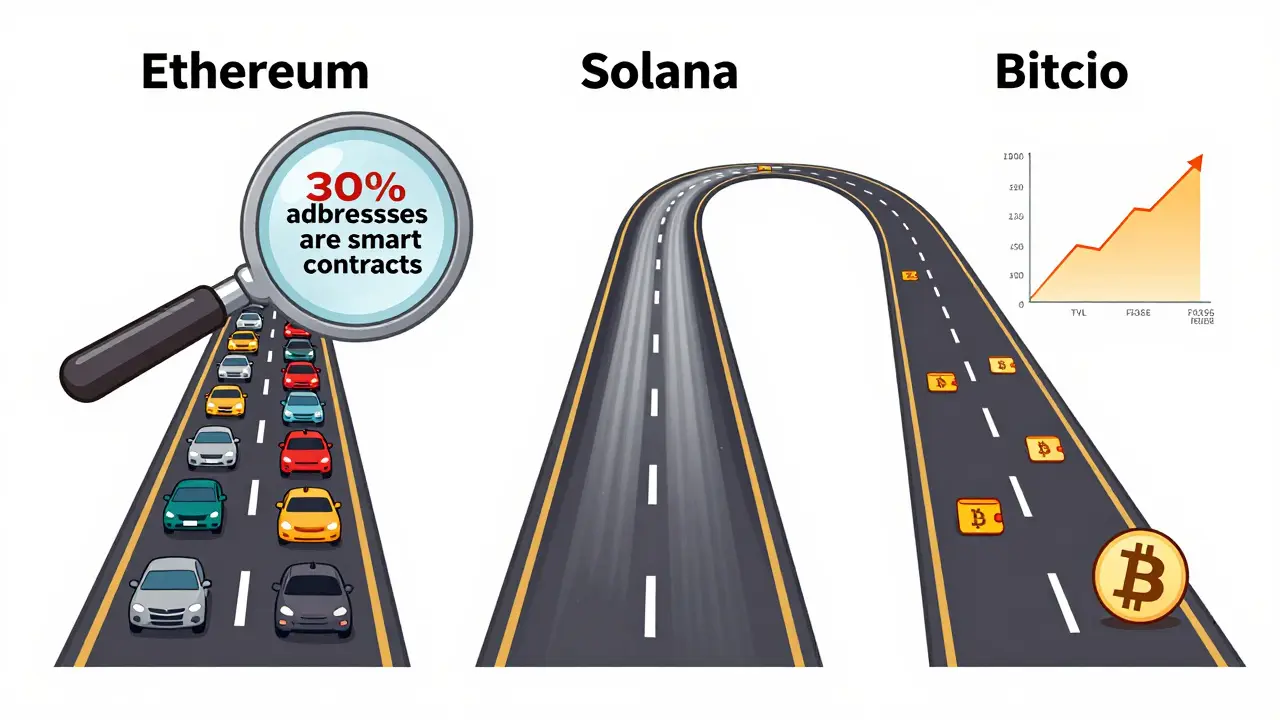
Here’s the big problem: one person can have 10, 50, or even 100 wallets. A trader might use one for DeFi, one for NFTs, one for staking, and another for trading on a DEX. A company might run dozens of smart contracts, each with its own address. A miner or validator gets counted every time they collect rewards - even if they’re not doing anything new. That’s why active addresses ≠ active users. Nansen.ai says it plainly: “Not all addresses represent unique users.” If you treat them as the same, you’ll overestimate adoption. You might think a blockchain is exploding, when it’s just one whale moving funds between 20 wallets. And then there are smart contracts. Most platforms count them as active addresses too. That’s fine for developers, but misleading for users. A DeFi protocol like Uniswap might have 100,000 active contract addresses - but only 5,000 of those are real human wallets. The rest are automated bots, arbitrage scripts, or staking pools. That’s why smart analysts don’t look at active addresses alone. They pair it with other metrics:- Transaction volume - How much value is actually moving? A spike in addresses with low volume? Probably just gas spam or dust transfers.
- Total Value Locked (TVL) - Are people locking real money into protocols? That’s trust.
- Fee revenue - Are users paying for services? If fees are rising with address growth, it’s organic.
- NVT Ratio - Network Value to Transactions. If the market cap is high but transactions are flat, you might be in a bubble.
How Analysts Use Active Addresses in Real Practice
Institutional investors don’t rely on one chart. They cross-check. A hedge fund might pull data from Coin Metrics, Santiment, and Glassnode. Why? Because each platform calculates active addresses slightly differently. Santiment excludes the top 100 exchange deposit addresses to filter out trading noise. Coin Metrics includes every transaction, even failed ones. Amberdata counts addresses involved in block validation. That’s why reported numbers can vary by 5-15%. You need to know the source. Most professionals use 7-day moving averages to smooth out weekend dips. Sundays are always quiet. Mondays bounce back. If you look at raw daily data, you’ll panic over false drops. Token Terminal now breaks down active addresses by category: DeFi, NFTs, Gaming. That’s huge. If Ethereum’s total DAA is flat, but DeFi addresses are up 18%, you know where the real action is. Maybe users aren’t leaving - they’re just moving from NFTs to lending protocols. And now, with Ethereum’s proto-danksharding, Coin Metrics introduced “Active Blob Addresses” - tracking wallets that interact with new data blobs. It’s not just about sending ETH anymore. The network is doing more. The metric had to evolve.How to Read the Numbers Like a Pro
Here’s how to cut through the noise:- Check the timeframe - Daily numbers are noisy. Weekly gives a clearer trend. Monthly shows long-term adoption.
- Look at the trend, not the spike - One day at 700K? Not meaningful. Three weeks at 700K+? That’s a floor.
- Compare to fee revenue - If addresses go up but fees stay flat or drop, it’s probably spam or bots.
- Check for exchange addresses - Are you looking at organic users or exchange deposits? Use tools that filter them out.
- Look at the source - Santiment? Glassnode? Coin Metrics? Each has a different methodology. Know which one you’re using.
The Future of Active Address Metrics
The next evolution? Behavioral scoring. Instead of just counting addresses, tools will start analyzing how they behave. Are addresses sending small amounts repeatedly? Probably bots. Are they interacting with multiple protocols over time? Likely real users. Are they holding tokens after transacting? That’s commitment. Messari’s 2023 report predicts machine learning will soon distinguish between human users and automated scripts. That’s the future. We’re moving from counting wallets to understanding behavior. The Interchain Foundation is even funding a $2.1 million project to create a “Unified Active Address Protocol” - a standard way to measure activity across blockchains. Right now, if you want to compare Ethereum to Solana, you’re comparing apples to oranges. That’s changing. But here’s the bottom line: active addresses aren’t going away. They’re too fundamental. Too transparent. Too hard to fake. Even if the metric evolves, the core idea won’t. Real usage leaves a trail. And that trail is what matters.What to Watch Next
If you’re tracking blockchain health, don’t just stare at price charts. Look at:- Daily active addresses on Ethereum, Solana, and Polygon
- Fee revenue trends on each chain
- TVL changes in top DeFi protocols
- Whether new DApps are gaining traction - not just launching
Are active addresses the same as unique users?
No. One person can control multiple wallet addresses. A trader might use one for DeFi, another for NFTs, and a third for staking. A single user can appear as 5, 10, or even 50 active addresses. That’s why analysts pair this metric with others like fee revenue and TVL to estimate real user behavior.
Why do different data providers show different active address numbers?
Each platform uses slightly different rules. Santiment filters out top exchange deposit addresses. Coin Metrics counts every transaction, even failed ones. Glassnode might include validator rewards differently. These small methodological differences can cause 5-15% variation in reported numbers. Always check the source and methodology.
Can active addresses be manipulated?
Yes, but not easily. Airdrop farming - where users create dozens of wallets to claim tokens - can artificially inflate numbers. The Blast protocol saw a 400% DAA spike in June 2023 from this, then crashed 92% within weeks. Smart analysts look for sustained growth over time, not one-day spikes. Long-term trends are harder to fake.
Should I use daily, weekly, or monthly active addresses?
Daily is noisy - good for spotting short-term spikes. Weekly smooths out weekend dips and gives a clearer picture. Monthly is best for spotting long-term adoption trends. Most professionals use a combination: daily to catch anomalies, monthly to confirm direction.
Do smart contracts count as active addresses?
Yes. Any address that interacts with the blockchain - whether it’s a human wallet or a smart contract - is counted. That’s why you need to look at other metrics like TVL and fee revenue to separate real user activity from automated contract interactions. Some platforms now offer separate counts for “active smart contract addresses” to help with this.
15 Comments
This whole post is just Wall Street jargon dressed up as blockchain insight. Active addresses? Please. They’re just tracking ghosts. The real game is who controls the data feeds - and it ain’t you.
You think these numbers mean anything? Last year, 3 million Solana addresses ‘activated’ - turns out 80% were bots created by a single dev in a garage. We’re being played. The whole metric is a scam.
I appreciate the depth here, honestly. It’s rare to see someone break down why raw numbers lie. I’ve watched friends chase DAA spikes and get burned - then realize the real story was in fee revenue and contract interactions. Slow data beats hype every time.
The idea that active addresses are a meaningful metric is a relic of 2021. We’re past the era of counting wallets like they’re lottery tickets. The future isn’t in tracking addresses - it’s in behavioral clustering. Who’s transacting? How often? With whom? And for how long? That’s the real signal. Everything else is noise dressed in charts.
There’s a lot to unpack here, and I think most people miss the point. Yes, active addresses don’t equal users - but they’re still the best *starting point*. The key is context. Pair them with TVL, fee growth, and contract interaction depth. For example, if a chain’s active addresses go up 20% and fee revenue jumps 60%, that’s not spam - that’s real adoption. I’ve seen this pattern repeat across three different chains. It’s not magic. It’s math.
The author demonstrates a commendable grasp of blockchain analytics. However, one must acknowledge that even the most sophisticated metrics are subject to systemic bias. The exclusion of exchange addresses, while theoretically sound, fails to account for the latent liquidity that underpins network velocity. One cannot isolate activity from liquidity without distorting the underlying economic reality.
I used to obsess over daily active addresses. Then I started looking at how long addresses stayed active. Like, if a wallet sends a transaction and then disappears for 30 days? That’s not adoption. That’s a one-time airdrop grab. But if it’s sending weekly, interacting with 3+ protocols, holding ETH or stablecoins? That’s a user. I built a simple script to track retention. It changed everything for me.
Active addresses mean nothing without context. I’ve seen chains with 500k daily addresses but $200k in daily fees - that’s spam. Real users pay. Real users stay. Real users don’t vanish after a free token.
I’ve been in crypto since 2017. We used to track transactions. Then we tracked unique addresses. Now we track blob interactions. The truth? The metric evolves because the network evolves. Ethereum isn’t just ETH anymore. It’s a data layer. A settlement layer. A global state machine. So yes - the definition of ‘active’ has to change. That’s not confusion. That’s progress.
You know what’s wild? People still treat this like it’s a new idea. We’ve known since 2015 that one person can have 50 wallets. The fact that we’re still having this conversation means we’re stuck in 2021. Time to move on.
I think you’re right about the need to combine metrics, but I think you missed one: number of unique *contract* interactions. Like, if 100k addresses interact with 10 different DeFi protocols, that’s way more meaningful than 100k addresses all just sending ETH to each other. That’s real ecosystem growth.
The methodology employed by Santiment and Coin Metrics is fundamentally flawed due to the lack of standardized definitions across data providers. This inconsistency undermines the credibility of all derived insights. A unified protocol, as referenced, is not merely desirable - it is imperative.
I used to think active addresses were everything. Then I watched a chain explode to 2M daily addresses - then crash to 200K. Turned out it was one team deploying 500k wallets for an airdrop. The market didn’t crash because of price. It crashed because the *behavior* vanished. Numbers lie. Patterns don’t.
They’re all lying. Every single data provider. They’re all owned by the same VC firms. The ‘active address’ metric? It’s just another tool to make you think a chain is growing so you buy in before they dump. I don’t trust any number that doesn’t come from a node I run myself.
In India, we see this all the time - people create multiple wallets to claim airdrops from foreign chains. Then they disappear. But the numbers still go up. That’s why we look at transaction value per address. If it’s under 0.01 ETH? Probably not real. If it’s over 0.1 ETH? Maybe someone’s actually using it.