
99Ex Crypto Exchange Review: Is It Legit or a Scam?
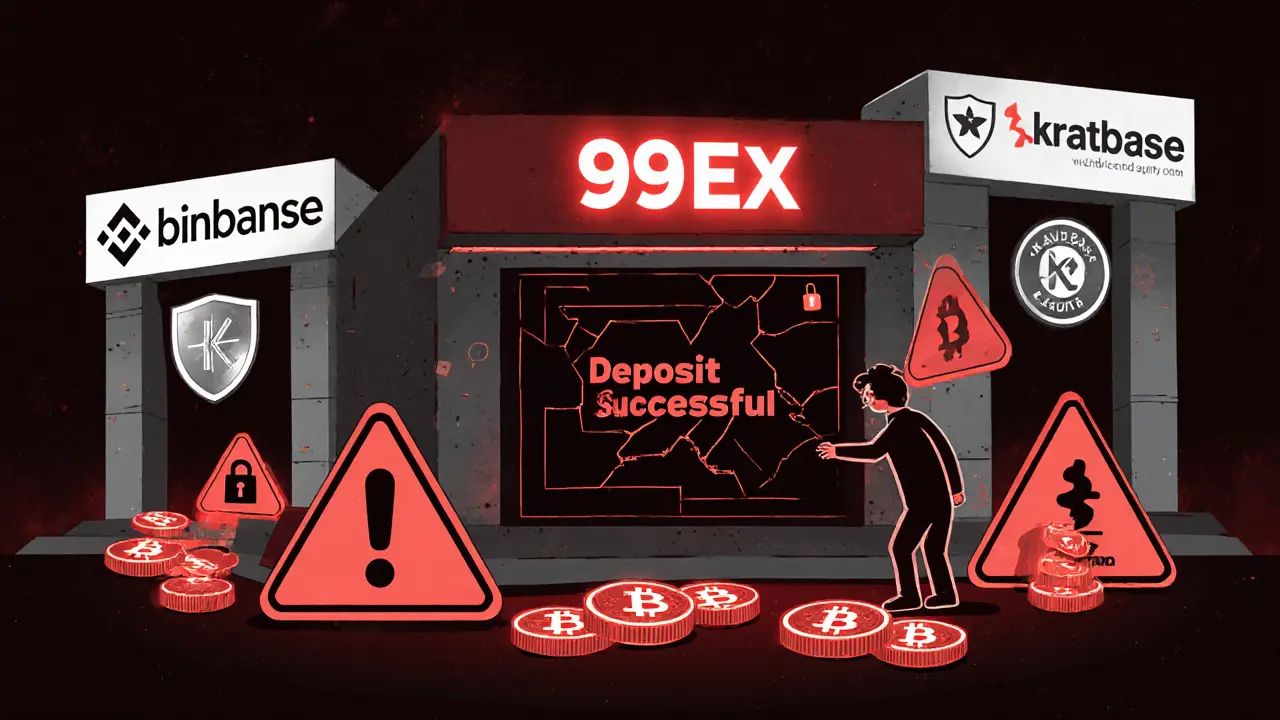
There is no such thing as a legitimate cryptocurrency exchange called 99Ex. Not now. Not ever. If you’ve seen ads, YouTube videos, or Telegram groups pushing 99Ex as the next big thing in crypto trading, you’re being targeted by a scam.
Every major crypto security report from 2024 and 2025 - including Chainalysis, the Cloud Security Alliance, and Beyond Identity - lists the top exchanges by trading volume and security ratings. Binance, Coinbase, Kraken, Bybit, and OKX dominate the market. None of them are 99Ex. Not even close. There are no verified user reviews on Trustpilot, no Reddit threads discussing its interface, no CertiK or Hacken audit reports, and no proof of reserves published anywhere. If 99Ex were real, it would show up in at least one of these places. It doesn’t.
Why You Won’t Find Any Real Information About 99Ex
Scammers create fake exchange names like 99Ex to sound plausible. They pick numbers (99) because people associate them with “almost perfect” or “top-tier.” They use the word “exchange” because it’s a trusted term in crypto. But real exchanges don’t hide. They publish security audits. They list their team. They have customer support that answers emails. They’re mentioned in news outlets when they get hacked - like Bybit in February 2025, when $1.5 billion was stolen. That incident made headlines. 99Ex? Silent.
Search engines return nothing credible. No official website with a verifiable domain. No LinkedIn profiles for its “founders.” No registered business in any jurisdiction. Even the domain name registration records, if you check them, likely point to a privacy-protected server in a country with no crypto regulations. That’s not a coincidence. That’s a red flag.
How These Scams Work
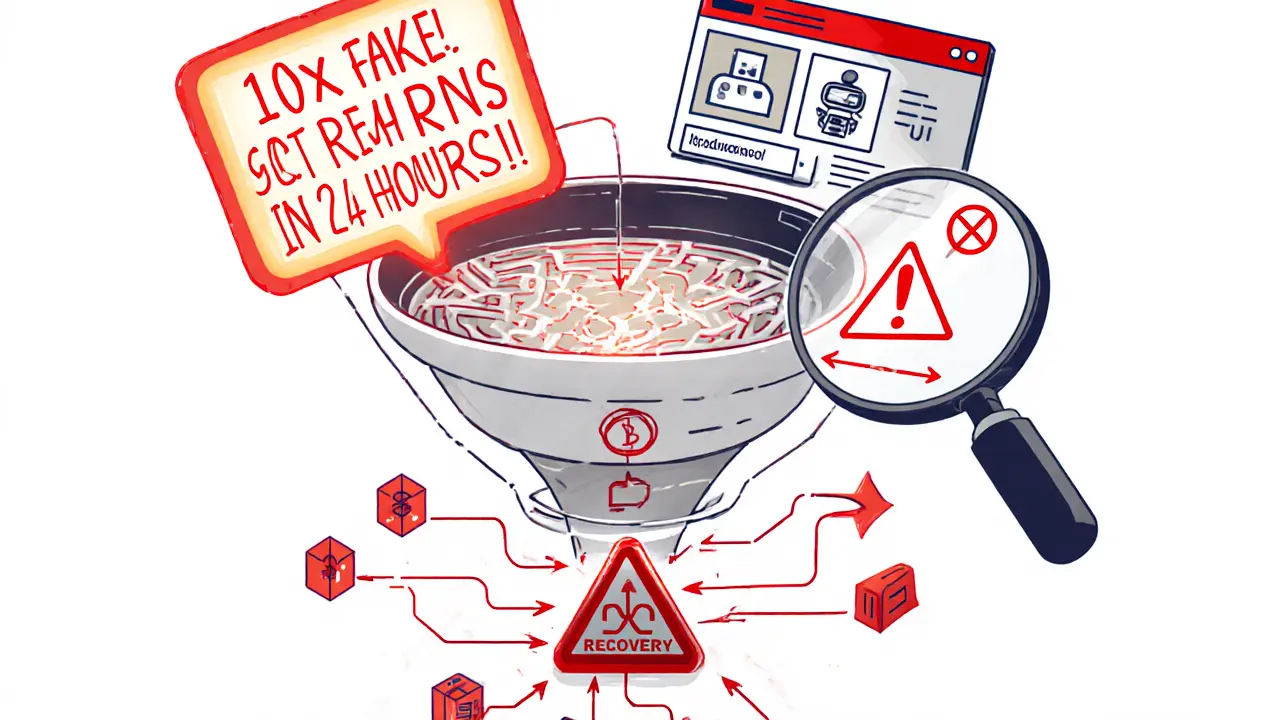
The pattern is always the same. You click on a flashy ad promising “10x returns in 24 hours” or “zero fees on all trades.” You’re directed to a website that looks professional - clean design, fake testimonials, even a live chatbot that replies instantly. You deposit your Bitcoin or Ethereum. At first, it seems fine. Your balance goes up. You try to withdraw. Suddenly, you’re asked for more fees - “verification fee,” “tax clearance,” “liquidity deposit.” You pay. Then they disappear. Your account vanishes. Your money is gone.
These platforms don’t trade crypto. They don’t even have wallets. They’re just landing pages built to steal funds. Once you send crypto to their address, it’s immediately moved through mixers and out of reach. No one can trace it back. No one can recover it.
What Real Exchanges Do Differently
Legitimate exchanges like Binance and Crypto.com don’t just say they’re secure - they prove it. Crypto.com holds a $750 million insurance fund for user assets. Binance stores over 95% of its users’ funds in cold storage. Both undergo quarterly audits by top cybersecurity firms. They publish their proof of reserves monthly so you can verify that your Bitcoin is actually there.
They also require multi-factor authentication (MFA), withdrawal whitelisting, and IP restrictions. They don’t ask you to pay to withdraw. They don’t pressure you with countdown timers. They don’t promise guaranteed returns. If someone tells you otherwise, they’re lying.

Red Flags You Can’t Ignore
- No official website with HTTPS and a verifiable domain (e.g., 99ex.com - if it exists, check its WHOIS record)
- No team members listed with real LinkedIn profiles
- No security audits from CertiK, Hacken, or PeckShield
- No presence on CoinMarketCap or CoinGecko
- Only promoted through Telegram, TikTok, or fake YouTube influencers
- Guaranteed profits or “risk-free trading” claims
- Pressure to deposit quickly - “Limited time offer!”
If even one of these is true, walk away. Don’t even create an account.
What Happens If You Deposit Anyway?
You lose your money. Period. There’s no chargeback system in crypto like there is with credit cards. Once you send funds to a scam exchange, they’re gone forever. Law enforcement can’t recover it. The blockchain doesn’t have a “undo” button. And because these platforms operate anonymously, there’s no company to sue, no customer service to call, no headquarters to visit.
In 2023, hackers stole $2.38 billion from crypto users - mostly through fake exchanges, phishing sites, and impersonation scams. In 2024, that number jumped 103% to over $1.34 billion from North Korean hacking groups alone. You’re not a target because you’re naive. You’re a target because you’re trusting. And scammers count on that.
How to Stay Safe
Only use exchanges that:
- Are listed on CoinMarketCap or CoinGecko
- Have been operating for at least 5 years
- Have published recent proof of reserves
- Require MFA and withdrawal whitelisting
- Have a public support team with email and live chat
- Are regulated in a major jurisdiction (U.S., EU, Singapore, Japan)
Stick to the top 5: Binance, Coinbase, Kraken, Bybit, and OKX. They’re not perfect, but they’re the only ones with real accountability.
Still Not Sure? Do This
Google “99Ex scam” or “99Ex review.” You’ll find dozens of posts from people who lost money. Check Reddit’s r/CryptoCurrency or r/Scams. Search for “99Ex” on Chainalysis’ public reports. You won’t find it. That’s not an accident. That’s the truth.
If you already deposited funds into 99Ex, stop trying to recover it through their “support.” That’s a second layer of the scam. Report it to your local financial regulator and file a report with IC3 (Internet Crime Complaint Center). You won’t get your money back, but you might help stop them from targeting someone else.
There is no shortcut in crypto. No hidden gem exchange with no name and no track record. If it sounds too good to be true, it is. And 99Ex? It’s not an exchange. It’s a trap.
Is 99Ex a real crypto exchange?
No, 99Ex is not a real crypto exchange. There is no verifiable evidence it exists as a legitimate platform. No security audits, no regulatory licenses, no user reviews on trusted sites, and no presence on major crypto data trackers like CoinMarketCap. It’s a scam site designed to steal cryptocurrency deposits.
Why can’t I find any information about 99Ex online?
Because it doesn’t exist as a real business. Legitimate exchanges are documented in industry reports, listed on financial trackers, and reviewed by security firms. 99Ex appears nowhere in these records. The only results you’ll find are from scam websites promoting it or users warning others about losing money to it.
What should I do if I already sent crypto to 99Ex?
Stop all communication with them immediately. Do not send more funds for “recovery fees” - that’s a second scam. File a report with your country’s cybercrime unit and IC3 (Internet Crime Complaint Center). Unfortunately, crypto transactions are irreversible, so recovering your funds is extremely unlikely. Your best action now is to warn others and learn how to spot scams in the future.
Is 99Ex the same as 99bitcoins.com?
No, they are completely different. 99bitcoins.com is a legitimate educational website that has been teaching people about Bitcoin since 2013. It does not trade crypto or hold user funds. 99Ex is a fake exchange with no connection to 99bitcoins. Confusing the two is a common trick scammers use to make their site seem more credible.
Which crypto exchanges are actually safe to use?
Stick to well-established, regulated exchanges like Binance, Coinbase, Kraken, Bybit, and OKX. These platforms have public security audits, insurance funds, proof of reserves, and multi-factor authentication. They’ve been operating for years and are regularly reviewed by cybersecurity experts. Avoid any exchange you’ve never heard of, especially if it’s promoted through social media ads or Telegram groups.
13 Comments
The absence of any official audit or regulatory registration is not just a red flag-it’s a neon sign screaming fraud. Every legitimate exchange leaves a digital fingerprint. 99Ex? Nothing. Not even a ghost. This isn’t ignorance, it’s malice disguised as opportunity.
So let me get this straight-we’re supposed to trust Binance because they’ve been around long enough to get famous, not because they’re actually trustworthy? The fact that you’re treating brand recognition as proof of safety is the real scam.
Been there, lost crypto. Don’t let anyone tell you it’s your fault. Scammers are getting smarter every day. Just stay away from anything that sounds like a miracle.
Honestly? I didn’t even know 99Ex was a thing until I saw someone post about it on Discord yesterday. Then I googled it and immediately saw the red flags. Glad someone took the time to lay it all out like this.
Let’s be real-the top 5 exchanges are all centralized, monitored, and compromised at some point. You’re just choosing which dumpster fire you want to sit next to. At least 99Ex doesn’t pretend to be a bank.
I appreciate how thorough this is. I’ve seen so many people get burned by these fake platforms and no one ever explains why they’re fake-just says ‘don’t use it.’ This helps people actually understand the warning.
You think this is bad? Wait till you hear about the Telegram group that’s impersonating Kraken’s support team right now. They’re using the same exact template as 99Ex. I’ve already reported three accounts. Someone needs to shut this down before more people lose everything.
This entire post is a distraction. The real issue is that Western governments control the narrative around crypto. If 99Ex were real they would be banned by the SEC not because it’s a scam but because it threatens their monopoly on financial control. You’re being manipulated into trusting institutions that have stolen trillions through inflation.
Who cares if it's on CoinMarketCap you're just scared of new things because you don't understand them. Maybe 99Ex is decentralized and doesn't need to show off like some corporate zoo. The fact you trust Binance means you're already owned
I get where you’re coming from but I also think we need to be careful not to dismiss every new project too quickly. Maybe 99Ex is just too small to be on the radar yet? I’d rather see people educate themselves than just fear everything.
People like you are why this industry is toxic. You don’t get it. Scams exist because people like you refuse to take responsibility for their own decisions. If you deposit into a site with no reviews and no team, you’re not a victim-you’re a participant in your own downfall.
There’s a deeper truth here that no one wants to face: the entire crypto ecosystem is built on trust in systems that were never meant to be trusted. We’re told to avoid scams, but we’re never told why the infrastructure that enables them-the centralized exchanges, the regulatory capture, the opaque audits-isn’t the real scam. 99Ex is just the symptom. The disease is the illusion of decentralization.
Wow. Just… wow. That’s the first time I’ve heard someone actually frame this as a systemic critique instead of just another ‘don’t trust strangers’ post. You’re right. We’re not just avoiding scams-we’re avoiding the fact that the entire model is designed to make us feel safe while quietly extracting value.