
150-200 Million VND Fines for Crypto Payments in Vietnam: What You Need to Know
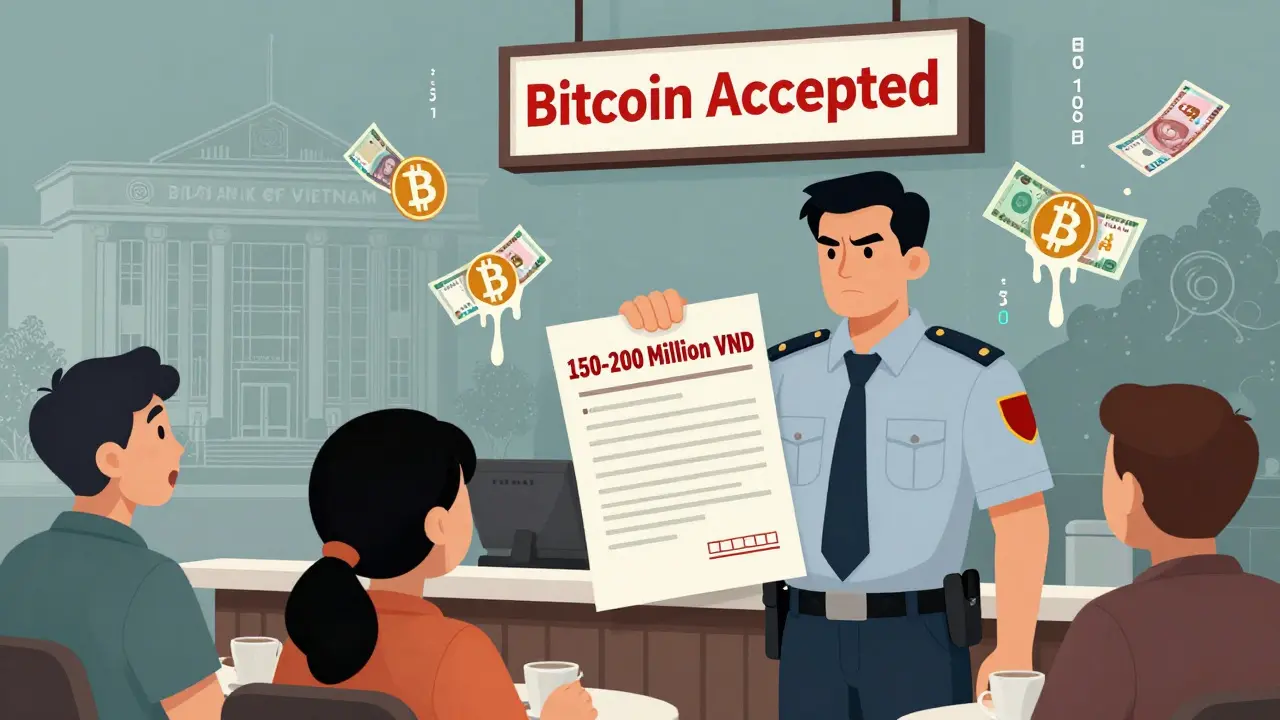
It’s 2026, and if you’re in Vietnam and you accept Bitcoin to pay for your coffee, your phone, or your rent, you could be hit with a fine of up to 200 million VND - that’s nearly $8,900 USD. This isn’t a rumor. It’s the law. And despite how common crypto use has become, the State Bank of Vietnam (SBV) still enforces this ban with real penalties.
Why Is Crypto Use as Payment Illegal in Vietnam?
Vietnam doesn’t ban owning Bitcoin or Ethereum. You can buy, hold, and trade them freely. But use them to pay for goods or services? That’s where the line is drawn. The legal basis comes from Decree No. 96/2014/ND-CP, which says any virtual currency used as a payment method is illegal. The SBV made this clear in October 2017: “The issuance, supply, and use of bitcoin and other similar virtual currencies as a means of payment is a prohibited activity in Vietnam.” The rule took effect on January 1, 2018, and it hasn’t changed since.The reasoning? Control. The central bank fears losing oversight of money flow. Bitcoin transactions are anonymous, irreversible, and outside the banking system. That makes it easy for tax evasion, money laundering, or untraceable payments - all things Vietnam’s financial regulators want to shut down. Le Truong Tung, president of FTP University, put it bluntly: “Accepting bitcoin as payment will make the economy quite complex and difficult to control.”
It’s not just about crime. It’s about sovereignty. If people start using Bitcoin as currency, who controls inflation? Who sets interest rates? Who protects consumers? The SBV says only state-approved payment tools - like bank cards, mobile wallets, and payment orders - should be used. Everything else is considered an illegal substitute.
How Much Is the Fine, and Who Gets Hit?
The penalty for using crypto as payment is fixed: between 150 million and 200 million VND. That’s not a warning. That’s a fine you pay upfront, no court needed. It’s an administrative sanction, not a criminal charge - unless the case involves large-scale fraud or organized crime.Who gets fined? Mostly businesses. Think of a tech startup accepting Bitcoin for SaaS subscriptions, a restaurant advertising “Pay with ETH,” or an online marketplace allowing crypto as payment. Even universities tried it back in 2017 - one planned to let students pay tuition in Bitcoin. The SBV stepped in immediately. The plan was scrapped within days.
Individuals rarely get fined for buying coffee with crypto. The system isn’t built to catch every person using a peer-to-peer wallet. But if you’re a merchant, especially one with a public-facing payment system, you’re a target. The General Department of Vietnam Customs reported in 2017 that daily crypto transactions in Vietnam were already worth thousands of U.S. dollars. That’s a lot of potential violations.
What About Holding or Trading Crypto?
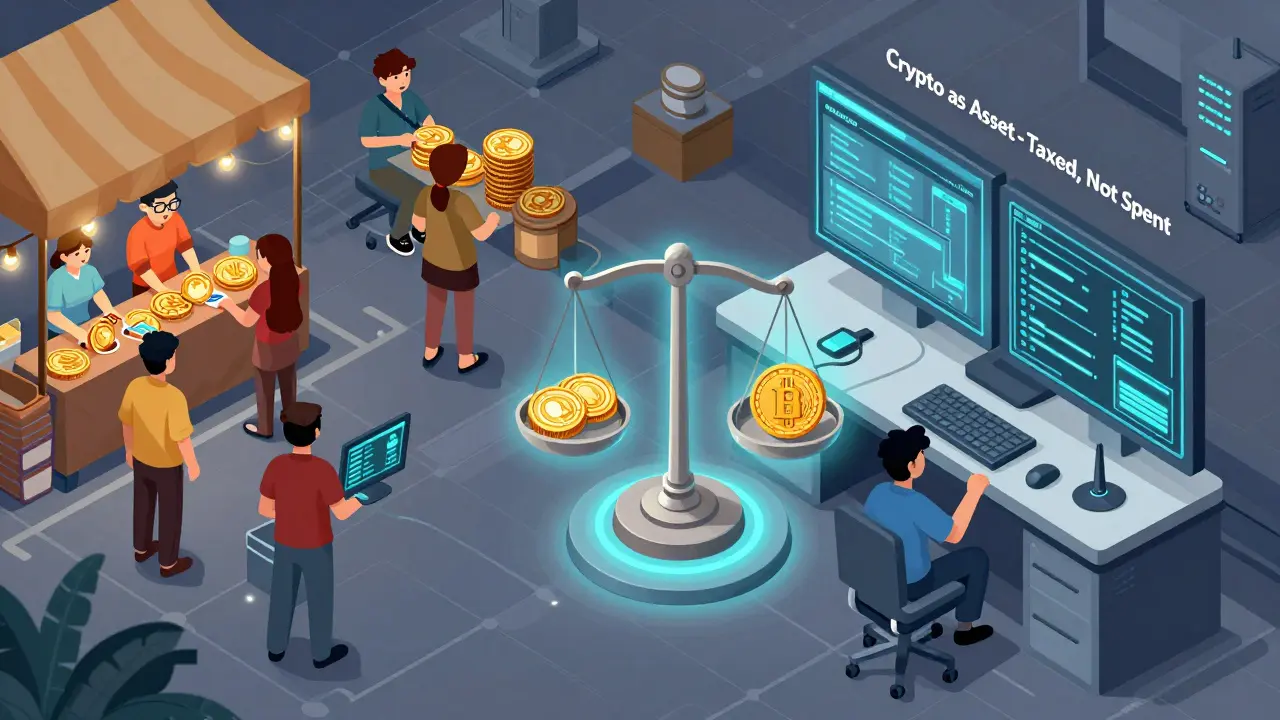
Here’s the twist: you can still own it. You can still buy Bitcoin on exchanges like Binance or local platforms. You can still trade it, hold it, or even mine it. The law only bans using it as a payment method. That creates a strange gray zone. Many Vietnamese hold crypto as an investment, not a currency. They treat it like gold - something to store value, not spend.This distinction matters. In 2021, Vietnam’s government circulated a draft decree that proposed treating crypto as a digital asset, not money. That means it could be taxed, regulated like securities, and tracked - but still not used to pay for goods. By 2022, the Ministry of Finance began drafting rules to tax crypto gains. That’s a big shift. They’re not legalizing crypto payments, but they’re starting to treat it like property. It’s a compromise: keep the ban on spending, but acknowledge it’s here to stay.
Why Is Vietnam Still Banning Crypto Payments When Everyone Else Is Adapting?
Compare Vietnam to its neighbors. Thailand licenses crypto exchanges. Singapore regulates digital tokens under its Payment Services Act. Even Indonesia and the Philippines have moved toward regulated crypto use. Vietnam didn’t go that route. It chose a hard line.Some experts think that’s outdated. Dr. Nguyen Xuan Thanh from Harvard’s Kennedy School said in 2018: “Vietnam’s approach reflects traditional central banking concerns, but fails to recognize cryptocurrency’s potential as a technological innovation.” Blockchain isn’t just about money - it’s about transparency, smart contracts, and secure record-keeping. Vietnam’s ban doesn’t stop people from using the tech. It just pushes it underground.
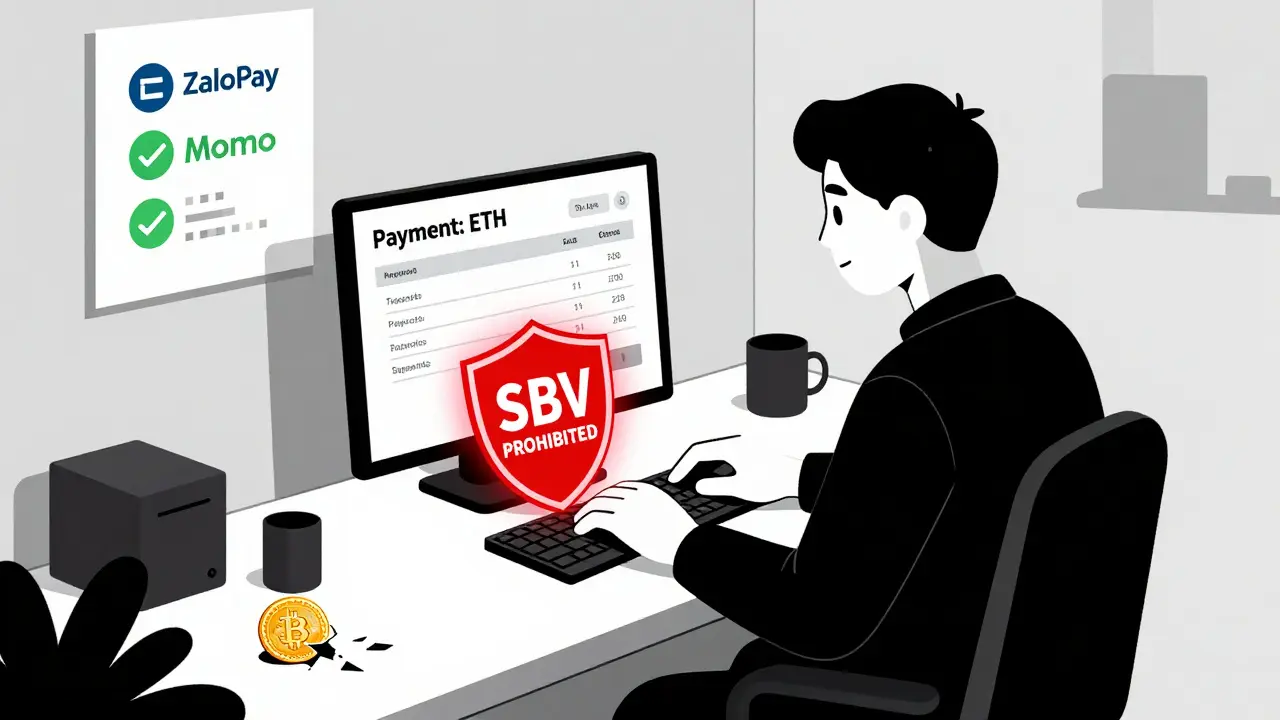
And people are still using it. Chainalysis ranked Vietnam 8th globally in crypto adoption in 2021 - higher than Japan and South Korea. The World Bank found 43% of Vietnamese adults used digital payments in 2020. That’s a huge appetite for alternatives to cash and traditional banking. The SBV’s answer? Push more people into ZaloPay, Momo, and ViettelPay - state-approved apps they control. But many young users still prefer crypto for its speed, lower fees, and global access.
Is the Fine Actually Enforced?
Here’s the reality: the 150-200 million VND fine looks scary on paper. But in practice, it’s rarely applied. There are no public records of hundreds of fines being issued. The SBV hasn’t released numbers on how many businesses have been penalized since 2018. Most enforcement happens quietly - warnings, shutdowns of crypto payment gateways, or pressure on platforms to remove crypto options.Dr. Tran Ngoc Ca from Vietnam’s Academy of Finance said in a 2023 interview: “The fine remains technically enforceable but has become increasingly difficult to implement as cryptocurrency usage grows.” That’s the truth. The law hasn’t changed. The technology has.
Today, peer-to-peer crypto trading is booming. Vietnamese users trade on Paxful, LocalBitcoins, and even Telegram groups. They convert crypto to cash through trusted intermediaries - no merchant system involved. That’s legal. As long as you’re not running a business that accepts crypto directly, you’re not breaking the law.
So while the fine exists, it’s more of a deterrent than a daily tool. The SBV is trying to control the narrative, not every transaction. They know they can’t arrest everyone using crypto. But they can shut down platforms that make it easy.
What Should You Do If You Run a Business in Vietnam?
If you’re a small business owner, freelancer, or e-commerce seller:- Don’t display crypto as a payment option. Even saying “We accept Bitcoin” on your website or social media can trigger a complaint.
- Don’t integrate crypto payment gateways. Tools like BitPay or Coinbase Commerce are blocked in Vietnam. Using them puts you at risk.
- Use approved payment methods. ZaloPay, Momo, VNPay, and bank transfers are safe. The SBV supports these - and they’re growing fast.
- Hold crypto as an investment, not cash. If you’re buying Bitcoin for long-term value, that’s fine. Just don’t use it to pay your suppliers or customers.
There’s no gray area here: if you’re accepting crypto as payment, you’re breaking the law. The fine is real. The risk is real. And the SBV doesn’t need to prove intent - just that the transaction happened.
What’s Next for Crypto in Vietnam?
The writing is on the wall. Vietnam won’t legalize crypto payments anytime soon. But it also won’t stop people from using it. The government is walking a tightrope: suppress spending, but regulate ownership. Tax gains. Block exchanges that don’t comply. Encourage digital payments - but only their version.By 2026, we’re likely to see more clarity on crypto taxation, stricter licensing for exchanges, and maybe even a central bank digital currency (CBDC) pilot. But don’t expect the payment ban to lift. The SBV isn’t giving up control. The 150-200 million VND fine is still the stick they use to keep crypto out of everyday transactions.
For now, if you want to use crypto in Vietnam, treat it like a savings account - not a wallet. Buy it. Hold it. Maybe even sell it for profit. But don’t try to spend it. The fine isn’t just a number. It’s a warning: this system doesn’t want you using crypto to pay.
Can I get fined for buying Bitcoin in Vietnam?
No, you cannot be fined for buying or holding Bitcoin in Vietnam. The law only bans using cryptocurrencies as a means of payment - not owning them. You can legally trade, store, or invest in Bitcoin through licensed exchanges. The fine applies only when you use crypto to pay for goods or services.
Is it illegal to accept crypto as payment for freelance work?
Yes. If you’re a freelancer and you invoice a client and accept Bitcoin or Ethereum as payment, that’s considered using crypto as a payment method - which violates Vietnam’s banking regulations. Even if the client is overseas, if the transaction occurs within Vietnam’s jurisdiction, you risk a fine of 150-200 million VND. The safest approach is to receive payment in VND via bank transfer or approved digital wallets.
Can I use crypto to pay for international services from Vietnam?
Technically, yes - but it’s risky. If you pay for a U.S.-based SaaS subscription with Bitcoin, the SBV may not track it. But if your Vietnamese bank account is linked to the transaction, or if the service provider is registered in Vietnam, you could still be flagged. The law targets any use of crypto as payment within Vietnam’s financial system. The safest route is to use a credit card or PayPal, both of which are legal and widely accepted.
Has anyone actually been fined for using crypto as payment?
There are no public records of individuals being fined for small personal transactions. However, in 2017, a university canceled its plan to accept Bitcoin for tuition after SBV warnings. In 2019, the SBV confirmed it had coordinated penalties for illegal crypto payment activities, but didn’t release numbers. Enforcement is focused on businesses, especially those with public payment systems. Individuals using P2P methods rarely get caught.
Will Vietnam ever legalize crypto payments?
Unlikely in the near future. The State Bank of Vietnam prioritizes control over innovation. While they’re moving toward taxing crypto as an asset, they’ve consistently rejected legalizing it as payment. Their focus is on promoting state-backed digital wallets like ZaloPay and Momo. A shift would require major changes in monetary policy - something the SBV isn’t showing signs of doing.
16 Comments
The regulatory architecture here is a classic case of monetary sovereignty being prioritized over decentralized financial innovation. The SBV’s stance reflects a central bank’s existential fear of losing seigniorage control, but it’s fundamentally misaligned with the technological trajectory of global finance. Crypto as a payment medium isn’t inherently destabilizing-it’s the opacity of the regulatory response that creates systemic friction. The real issue isn’t Bitcoin; it’s the absence of a coherent digital asset framework that can integrate blockchain’s auditability while preserving macroeconomic stability.
OH MY GOSH I JUST REALIZED THIS IS A REAL THING?? Like, imagine trying to pay for your bubble tea with ETH and then getting slapped with $8,900?? That’s not a fine, that’s a kidnapping. Vietnam’s trying to stop the future with a rubber stamp and a fax machine. I’m crying. Not because I use crypto-I don’t-but because people are being punished for using tech that’s already here. This is like banning the internet because some people used it to download cat videos. We need to fix this. NOW.
Typical socialist nonsense. Vietnam’s government is terrified of freedom. If you can’t control every dollar, you’re weak. That’s why they ban crypto payments-they’re too lazy to adapt. The real criminals are the bureaucrats who think they know better than millions of people choosing their own money. This law doesn’t protect the economy-it protects incompetence. And the fact that they’re fine with ZaloPay but not Bitcoin? That’s not regulation. That’s colonialism with a smartphone.
It is, in fact, a rather fascinating sociopolitical paradox: the State Bank of Vietnam, in its unwavering commitment to centralized monetary authority, has effectively rendered a nascent technological paradigm into an illicit artifact. One must contemplate the epistemological implications: if a medium of exchange is deemed illegitimate not on economic grounds, but on the basis of institutional anxiety, then one must question whether the regulatory framework is serving the public-or merely preserving the sanctity of bureaucratic hegemony. One wonders, too, if the 200 million VND fine is merely performative-a symbolic cudgel wielded to maintain the illusion of control.
There’s something poetic about how Vietnam is treating crypto like a wildflower growing through concrete-beautiful, resilient, and utterly inconvenient to the pavement-builders. You can’t outlaw innovation, only delay it. The fact that people are still trading on Telegram and P2P platforms proves the law is already obsolete. It’s not about crime or control-it’s about ego. The SBV wants to be the only voice in the room. But the room is full now. And the people aren’t asking for permission. They’re just paying. Quietly. Efficiently. Without permission.
Okay I just wanna say I’m so proud of how Vietnam is handling this-like, yeah the fine sounds crazy but honestly? I think they’re doing the right thing. I mean, imagine if everyone just started using crypto and then suddenly the whole economy got weird and nobody knew how much stuff cost anymore? Like, what if your rent went up because Bitcoin spiked? That’s terrifying. I get why they’re pushing Momo and ZaloPay-it’s safe, it’s familiar, it’s like your phone but for money. And honestly? I don’t need crypto to pay for my noodles. I just need it to work. And it does. So… yeah. I’m team SBV.
wait so u can own btc but not use it to buy coffee?? 😭 that’s like having a golden key but the door is locked. like whyyyy?? i just want to pay my friend back in dogecoin for my ramen 😭 i dont even care if its illegal i just wanna do it. also i use p2p on telegram and no one cares 😎
Let’s be clear: the law is unenforceable at scale. The SBV’s fine is a deterrent, not a tool. Enforcement is selective, focused on businesses that make crypto payments visible-like websites or apps. P2P transactions, cash conversions, and private deals are invisible to regulators. This isn’t about stopping crypto-it’s about controlling perception. The real story isn’t the fine. It’s the 8 million Vietnamese who are quietly building a parallel financial system, one Telegram message at a time. The SBV doesn’t have to win. They just have to make you feel like you’re losing.
There’s a deeper truth here that most people miss: the ban isn’t about money. It’s about identity. Vietnam has spent decades rebuilding its economic sovereignty after war and isolation. To allow decentralized currency is to surrender a piece of that hard-won narrative. The SBV isn’t afraid of Bitcoin. It’s afraid of what Bitcoin represents-freedom from state control, autonomy over one’s wealth, and the quiet rebellion of choosing your own system. That’s why the fine is so high. It’s not a penalty. It’s a ritual. A reaffirmation of who holds the power.
They ban crypto payments but let people trade it like crazy?? That’s not logic that’s hypocrisy. You can’t have it both ways. If it’s dangerous then ban it all. If it’s not dangerous then let people use it. Why make people lie about how they pay? Why not just say okay you can use it but pay taxes? Simple. But no. They want control. And control is their religion.
Foreigners don’t get it. Vietnam isn’t Europe. We don’t need your crypto. Our system works. We have ZaloPay. We have Momo. We have order. If you want chaos, go to the US. We don’t need your Bitcoin. The fine is justified. End of story.
The regulatory ambiguity here is intellectually untenable. By permitting ownership while prohibiting exchange, the State Bank of Vietnam has created a bifurcated financial ecosystem wherein asset appreciation is incentivized, but utility is criminalized. This is not merely inconsistent-it is economically perverse. One cannot simultaneously treat a digital asset as a store of value and deny its function as a medium of exchange without undermining its very nature as currency. The consequence is a black market of intermediaries, unregulated exchanges, and a profound erosion of trust in state institutions. One must ask: is this policy sustainable, or merely an act of temporal preservation?
Hey, I just want to say-I know this seems harsh, but think about it this way: if you’re a small business owner in Vietnam, you’re already juggling so much. Rent, staff, taxes, electricity bills… now you’re supposed to also worry about whether your customer paid you in Bitcoin? That’s a nightmare. The SBV’s rules might feel outdated, but they’re giving people a clear line: use the apps everyone knows, keep it simple, stay safe. And honestly? Momo and ZaloPay are amazing. They’re fast, cheap, and work even in villages. Maybe crypto is cool, but sometimes… the quiet solution is the better one. You don’t need to rebel to be free.
so like… if i buy a coffee with btc and the shop owner converts it to vnd right away… is that still illegal? like technically i paid in crypto but they didnt keep it?? 😅 i feel like this is the whole loophole everyone’s using. also i just use localbitcoins and cash out at a corner store… no one cares. they just take the cash. 🤷♀️
bro this is so funny. vietnam bans crypto payments but everyone uses it. i work with a startup here and they take btc but they just say it's a 'donation'. no one asks questions. the real problem? the government is too busy trying to control everything to notice that people already won. they're just playing catch-up with a broken calculator.
why do they even care?? like i pay my rent in btc and the landlord just cashes it out in 2 mins. who gives a shit?? the sbv is so behind they think they can stop the future with a fine. lmao. also i spelled bitcoin wrong on purpose. i dont care. 🤷♂️